Change Cache Synchronization Modes (Active/Passive)
The ability to change cache synchronization modes enables you to control data replication roles in an NCache Bridge. By switching between Active and Passive modes, you can enable smooth Disaster Recovery (DR) operations, site maintenance, or load balancing between distant data centers. The active cache replicates all data changes to the Bridge, while the passive cache receives updates only, serving as a hot standby until promoted. Using the NCache Management Center, you can change the synchronization mode of the clustered cache connected to the Bridge.
Using the NCache Management Center
Using the NCache Management Center, you can convert a passive cache in a Bridge to an active cache and vice versa as discussed below:
Change Active Cache to Passive
To convert an active cache in a Bridge to a passive cache, follow these steps:
Launch the NCache Management Center by browsing to http://localhost:9801 or
<server-ip>:9801.In the left navigation bar, click on Bridges. It will open up a list of pre-existing Bridges. From the list, select the Bridge Name and go to View Details.
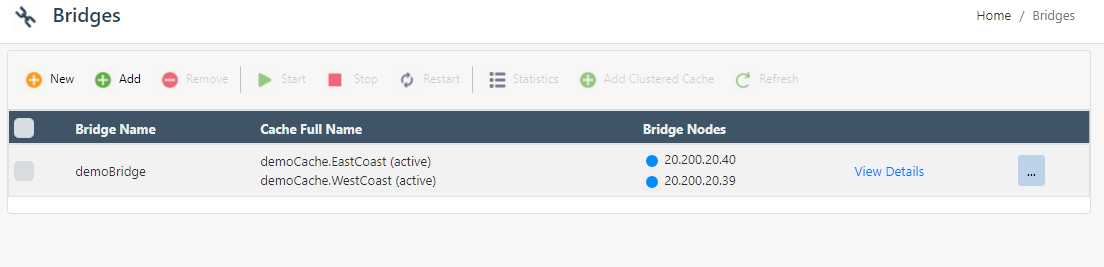
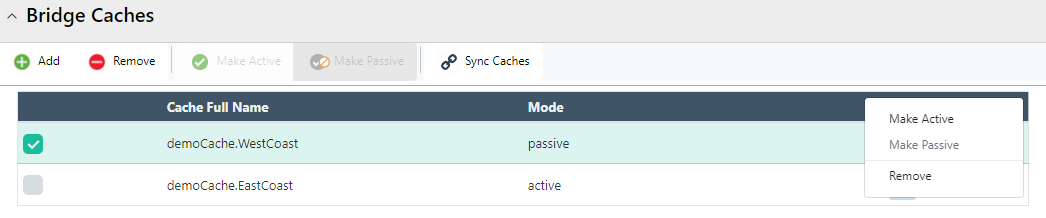
A new page opens up displaying the Bridge details. Under the Bridge Caches section, select the cache added to the Bridge.
Either click on the Make Passive button present at the top bar or click on the "..." button, and select the Make Passive option.
Change Passive Cache to Active
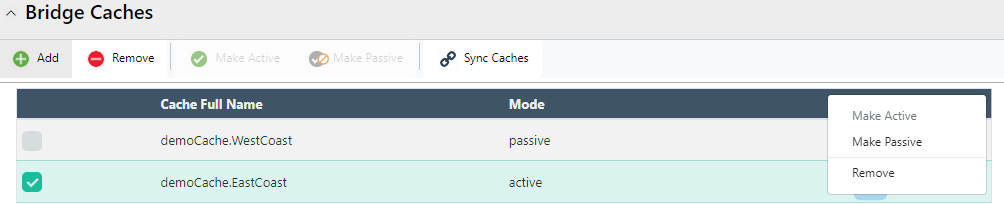
To convert a passive cache in a Bridge to an active cache, either click the Make Active button present at the top bar, or click on the "..." button and select the Make Active option.
Using PowerShell
The Set-BridgeCacheMode cmdlet enables users to change the mode of a cache participating in an NCache Bridge by setting it as Active or Passive.
- This command changes the mode of clustered cache defaultCache.WestCoast to active mode.
Set-BridgeCacheMode -Name defaultBridge -Server 20.200.20.11 `
                    -CacheFullName defaultCache.WestCoast -Mode Active
- This command changes the mode of clustered cache defaultCache.WestCoast to passive mode.
Set-BridgeCacheMode -Name defaultBridge -Server 20.200.20.11 `
                    -CacheFullName defaultCache.WestCoast -Mode Passive
- This command changes the mode of clustered cache defaultCache.WestCoast to active mode using security credentials.
Set-BridgeCacheMode -Name defaultBridge -Server 20.200.20.11 `
                    -CacheFullName defaultCache.WestCoast -Mode Active `
                    -Credentials(Get-Credential john_smith)
Note
The Set-BridgeCacheMode command can be used even when the load balancer is enabled.
See Also
Create Bridge
Configure Bridge Settings
Configure Conflict Resolver
Remove Cache from Bridge
