Cloud Environment
The Cloud Environment section provides a unified view of your active cloud deployment. While platform-specific references (such as Managed Resource Groups on Azure or CloudFormation Stacks on AWS) adapt to your deployment, the core dashboard layout, site topologies, and scaling controls function identically across both environments. Please note that this page uses the Azure Portal example.
Environment - Azure
The Environment - Azure panel summarizes the top-level metadata of your managed application

Environment Name: The unique identifier assigned to your deployment during initial setup (e.g.,
demo-app).Marketplace Plan: The billing and provisioning tier currently active (e.g., Free Trial, Hourly, or BYOL).
Environment Type: The deployment classification (e.g., Production).
Email Address: The email address you registered with.
Subscription ID: The target Azure Subscription hosting the deployment.
Managed Resource Group: The internal resource group auto-created by Azure to contain the underlying infrastructure (such as VMSS, Load Balancers, and Front Door profiles).
NCache Version: The installed NCache server release version (e.g.,
5.3.8).Location / Region: The primary Azure geographical region hosting the resources (e.g.,
eastus).Creation Date: The UTC timestamp indicating when the deployment was provisioned.
TLS: The current status (Enabled or Disabled) of cluster transport layer security.
Global Actions
Located in the upper-right corner of the Cloud Environment view, these controls manage cluster-wide states and scaling capacity:
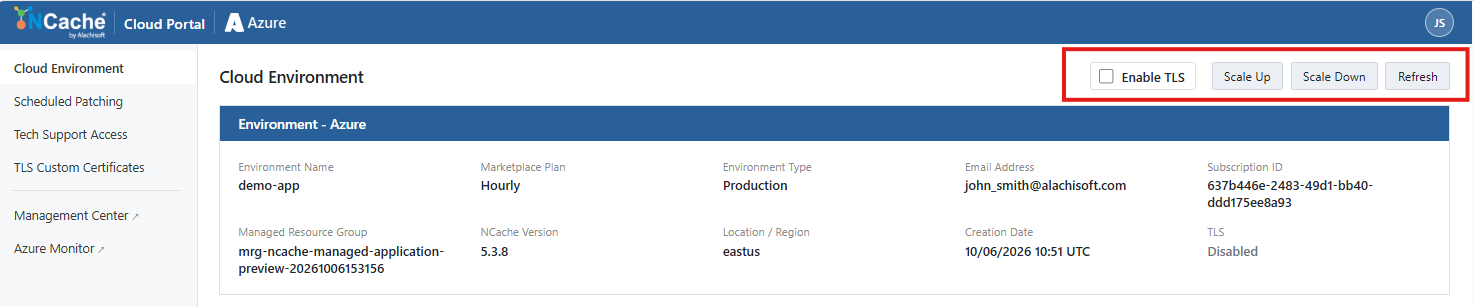
TLS:
Servers present a certificate, and clients verify it. Clients do not require a certificate of their own.
By default, NCache applies its built-in TLS certificate. If your organization requires certificates from its own certificate authority (CA), upload your custom PEM certificate files via the TLS Custom Certificates page before enabling this setting.
Mutual TLS:
- Servers require a certificate from every cache client, chained to a root trusted by the servers.
Important
- Cache clients that cannot present a trusted certificate will be refused once the rollout finishes.
- No root CA certificate is required when using NCache's default TLS certificate. If you are using custom TLS certificates, ensure you upload the corresponding root CA certificate from the TLS Custom Certificates page.
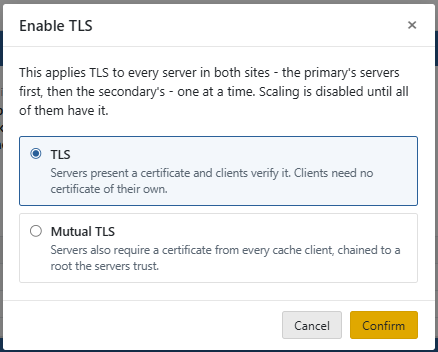
Click Confirm to begin the cluster-wide rollout, or Cancel to abort.
Add Server (Scale Up)
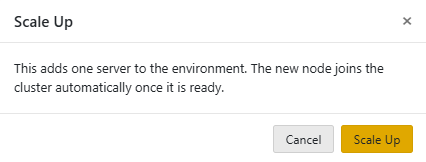
Initiates a horizontal scale-up operation to increase cluster capacity by provisioning an additional node:
- Click Add Server. You'll receive the following prompt to confirm.
- A top progress banner indicates that scaling is underway.
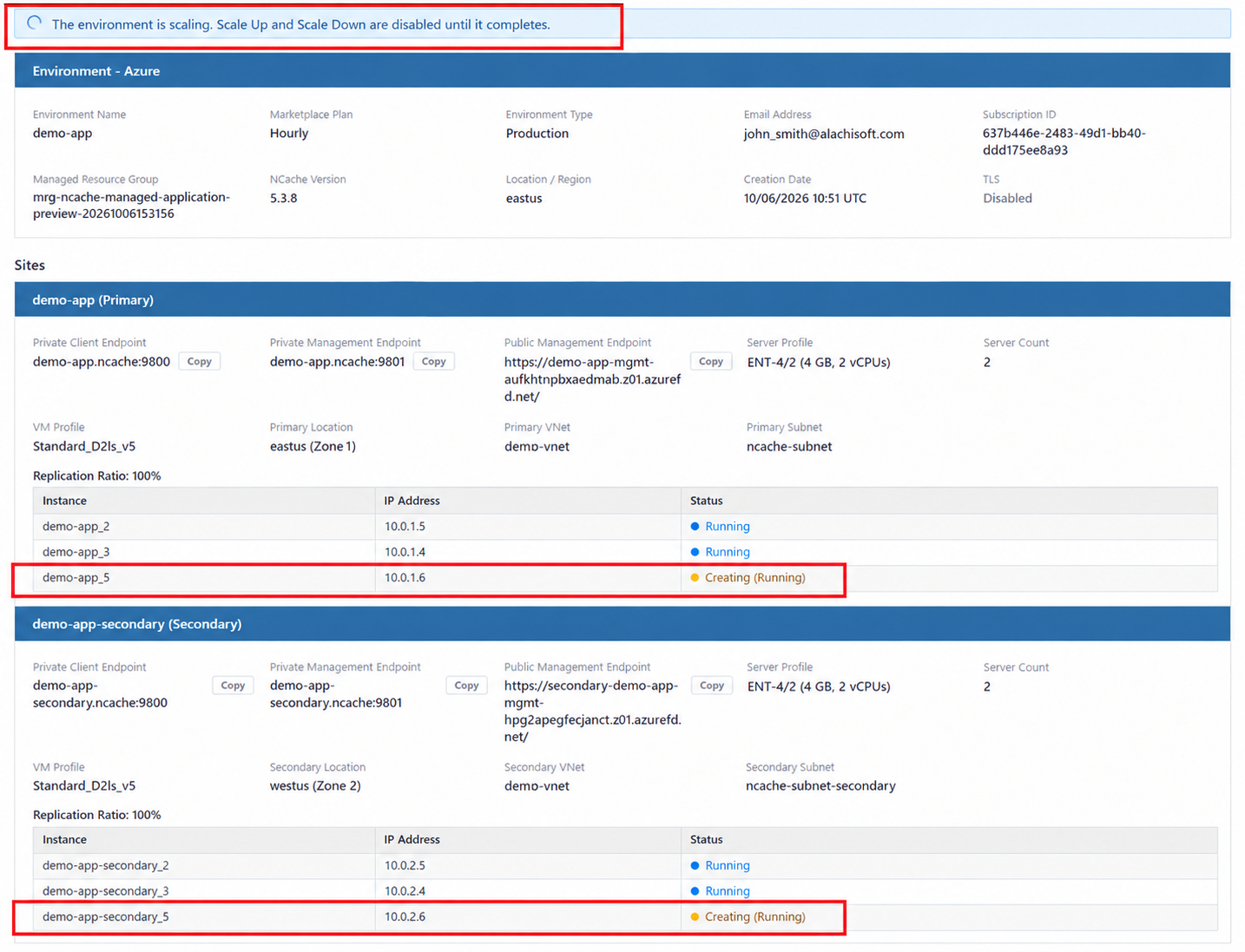
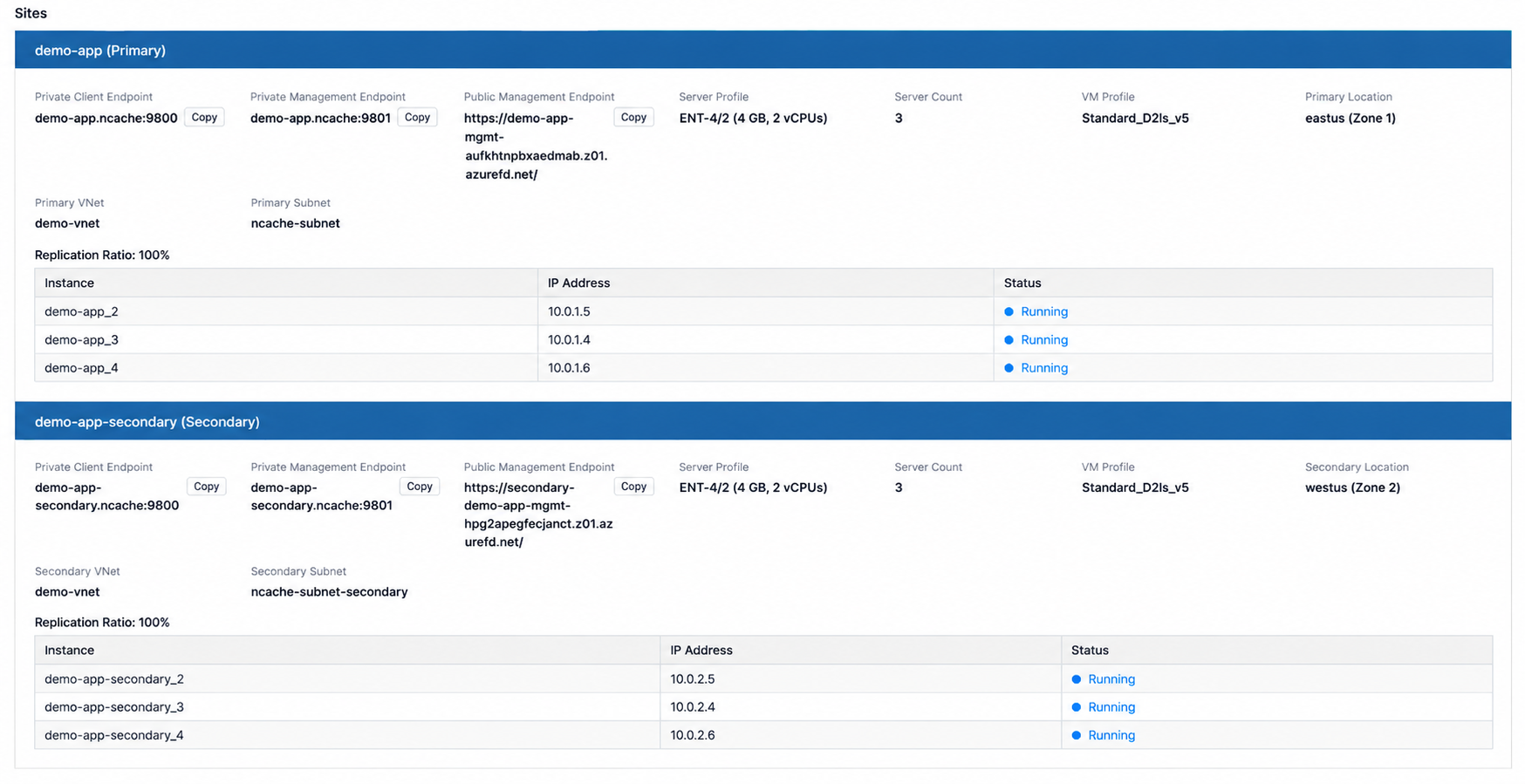
Azure automatically provisions a new VMSS host instance, pulls the NCache Docker image, starts the service, and seamlessly joins the node to the active cluster without downtime.
Once provisioning completes, the newly added node automatically appears in the instance table.
Remove Server (Scale Down)
Initiates a horizontal scale-down operation to decrease cluster size:
- Click Remove Server. You'll receive the following prompt to confirm.
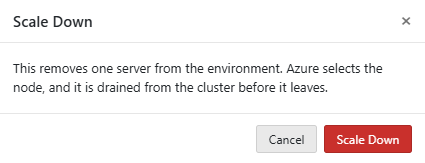
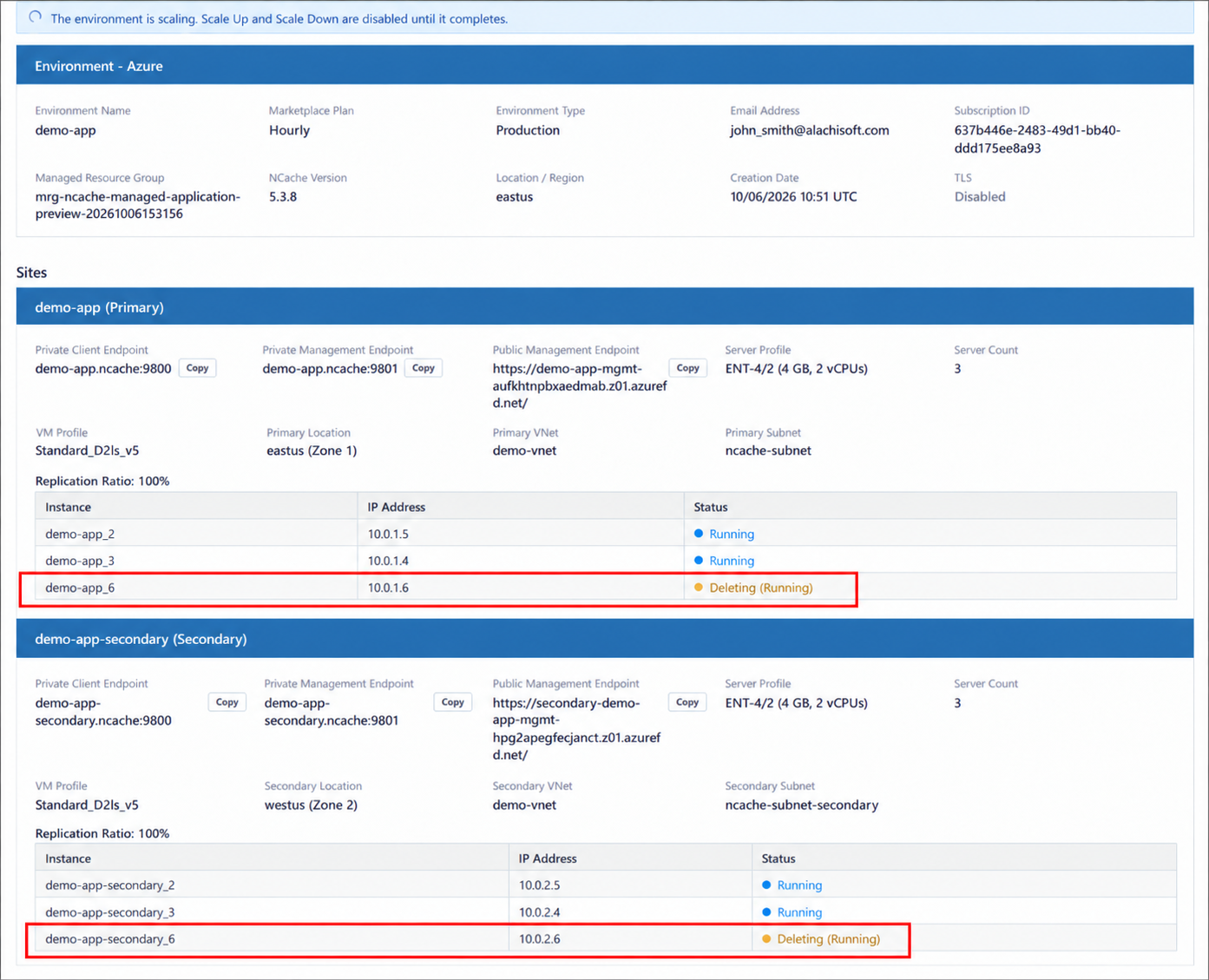
- A top progress banner indicates that scaling is underway. During this operation, both the Add Server and Remove Server buttons are temporarily disabled until the process completes.
Important
Data Safety and State Transfer: Before the node is deprovisioned, NCache performs an automated, graceful state transfer, migrating all active and replica data partitions to the remaining cluster nodes to prevent data loss.
- Deprovisioning: Because instance removal is orchestrated at the Azure Virtual Machine Scale Set (VMSS) level, you cannot select a specific node by name to delete. Azure automatically chooses which instance to deprovision based on standard scale set deletion logic.
Refresh
Polls the Azure Resource Manager and the underlying scale set to update node states, IP addresses, and operational metrics in real time.
Sites (Site Topology and Connectivity Endpoints)
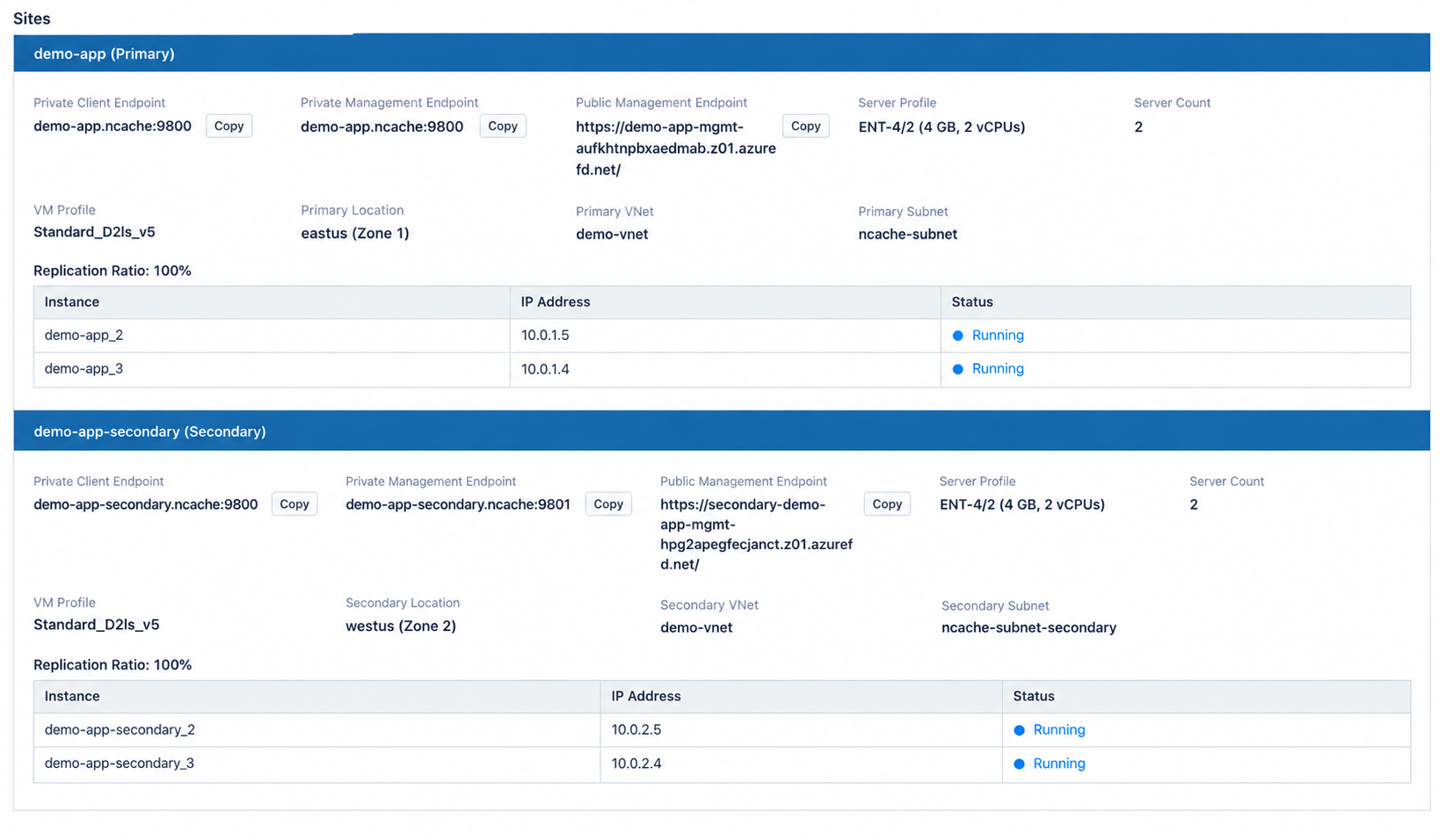
The Sites section displays the connectivity endpoints, infrastructure profiles, and individual node tables for each deployed site in your cluster.
In single-site setups, only the Primary site panel is displayed (e.g.,
demo-app (Primary)).In multi-zone or multi-region geo-replicated deployments, an additional Secondary site panel appears directly underneath (e.g.,
demo-app-secondary (Secondary)).
Each site block contains the following information:
Endpoints
Private Client Endpoint: The internal connection endpoint (e.g.,
demo-app.ncache:9800ordemo-app-secondary.ncache:9800) used by client applications running within the virtual network to perform cache read/write operations.Private Management Endpoint: The internal endpoint (e.g.,
demo-app.ncache:9801ordemo-app-secondary.ncache:9801) used for internal management commands, monitoring probes, and API operations.Public Management Endpoint: The secure Azure Front Door HTTPS address (e.g.,
https://demo-app-mgmt-aufkhthpbxaedmab.z01.azurefd.net/ClusteredCachesorhttps://secondary-demo-app-mgmt-hpg2apegfecjanct.z01.azurefd.net/ClusteredCaches) used to access the NCache Cloud Portal and Management Center from authorized external networks without exposing backend VMs.
Infrastructure Profile
Server Profile: The compute and memory tier allocated per node (e.g.,
ENT-4/2 (4 GB, 2 vCPUs)).Server Count: The total number of active VMs allocated to this specific site (e.g.,
2).VM Profile: The Azure VM series and SKU powering the scale set (e.g.,
Standard_D2ls_v5).Location: The geographical region and availability zone hosting the nodes:
Primary Location: Displays the primary zone (e.g.,
eastus (Zone 1)).Secondary Location: Displays the secondary zone/region (e.g.,
westus (Zone 2)).
VNet: The Virtual Network hosting this site's deployment (e.g.,
Primary VNet: demo-vnet/Secondary VNet: demo-vnet).Subnet: The dedicated subnet allocated to the cache nodes:
Primary Subnet:
ncache-subnetSecondary Subnet:
ncache-subnet-secondary
Replication Ratio: The provisioned capacity ratio between the primary and secondary sites (e.g.,
Replication Ratio: 100%).
Instance Listing
Each site panel includes a dedicated instance table listing all active VMSS nodes for that specific site:
Instance: The unique node identifier within the scale set (e.g.,
demo-app_2,demo-app_3for Primary, ordemo-app-secondary_2,demo-app-secondary_3for Secondary).IP Address: The private IP address assigned to each VM node within its respective subnet (e.g.,
10.0.1.5,10.0.1.4on Primary;10.0.2.5,10.0.2.4on Secondary).Status: The operational state of the instance, indicated by an active status (e.g., Running).
