Local Cache Configuration
The Local Cache Configuration page displays the configuration settings of a selected local cache. This view is opened by clicking View Details for a cache on the Local Caches page.
The toolbar provides options for starting, stopping, or restarting the cache, running Test-Stress, viewing statistics, and refreshing the displayed information. The availability of these operations depends on the current state of the cache.
Main
The Main page contains the basic storage and runtime settings of the local cache.
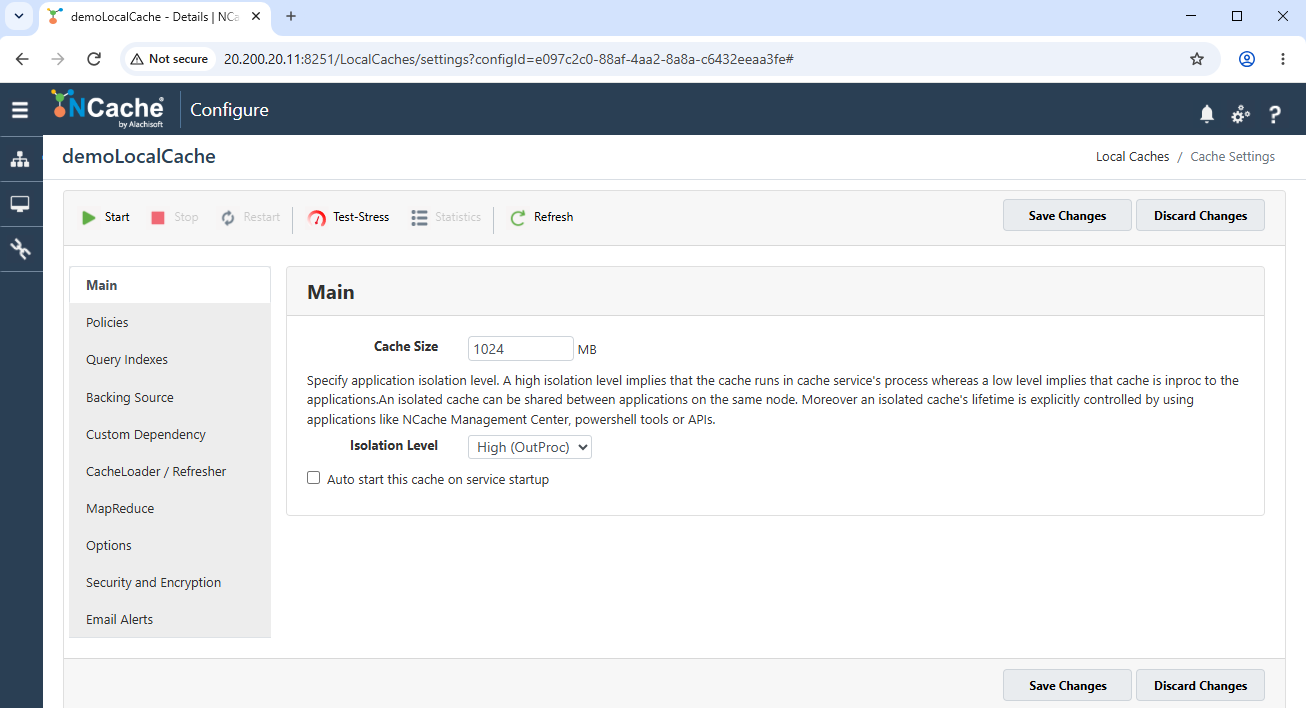
Cache Size specifies the maximum cache size in MB.
Isolation Level specifies whether the cache runs in the NCache service process or within the application process.
Auto start this cache on service startup determines whether the cache starts automatically when the NCache service starts.
Policies
The Policies page provides eviction and expiration settings that control how cache items are removed.
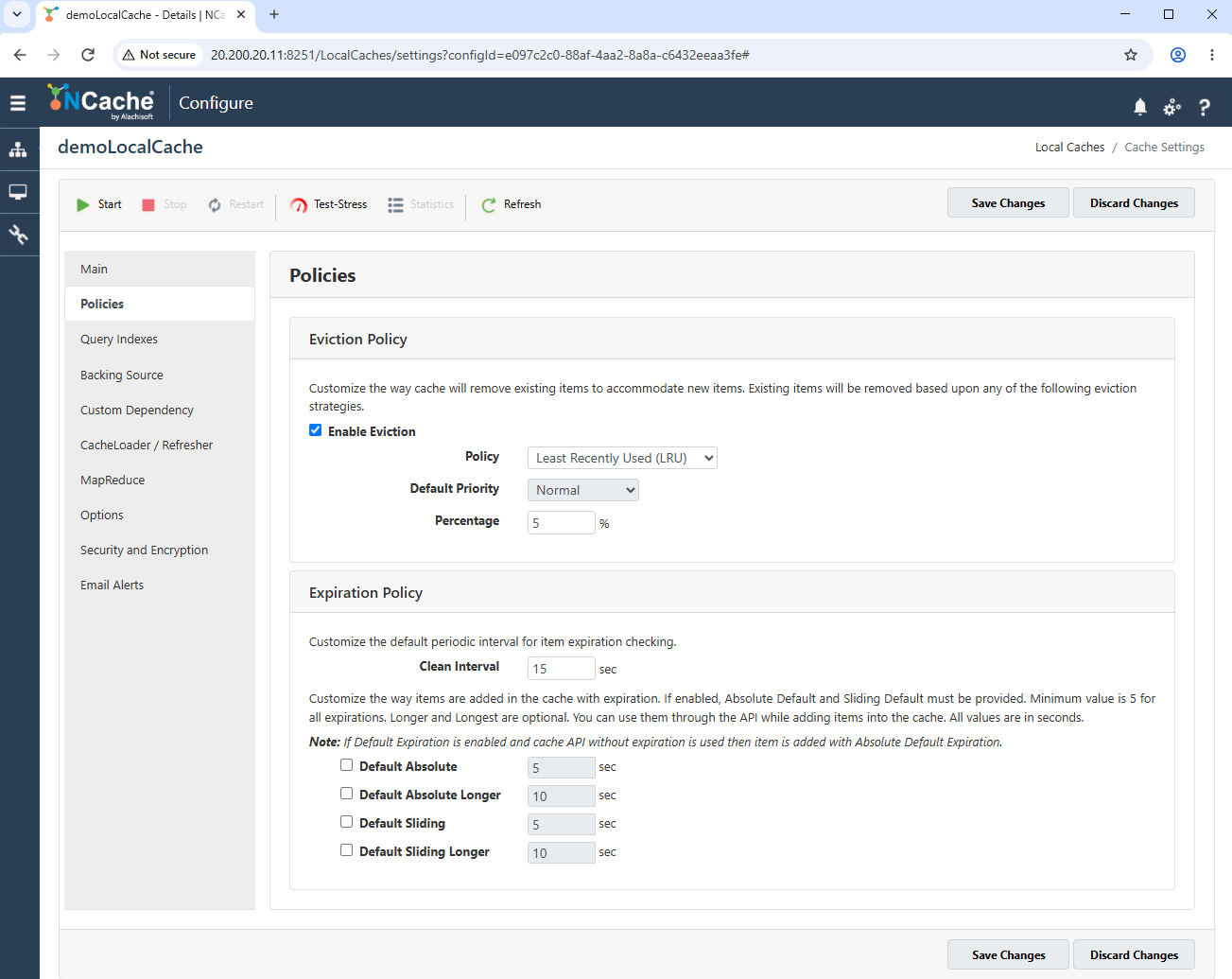
The Eviction Policy section allows eviction to be enabled and configured by selecting a policy, default priority, and eviction percentage.
Percentage specifies the percentage of cache data that is removed when eviction is triggered.
The Expiration Policy section provides the Clean Interval, which specifies how frequently the cache checks for expired items.
Default expiration values can be configured for Default Absolute, Default Absolute Longer, Default Sliding, and Default Sliding Longer.
Query Indexes
The Query Indexes page allows classes and their attributes to be configured for indexing.
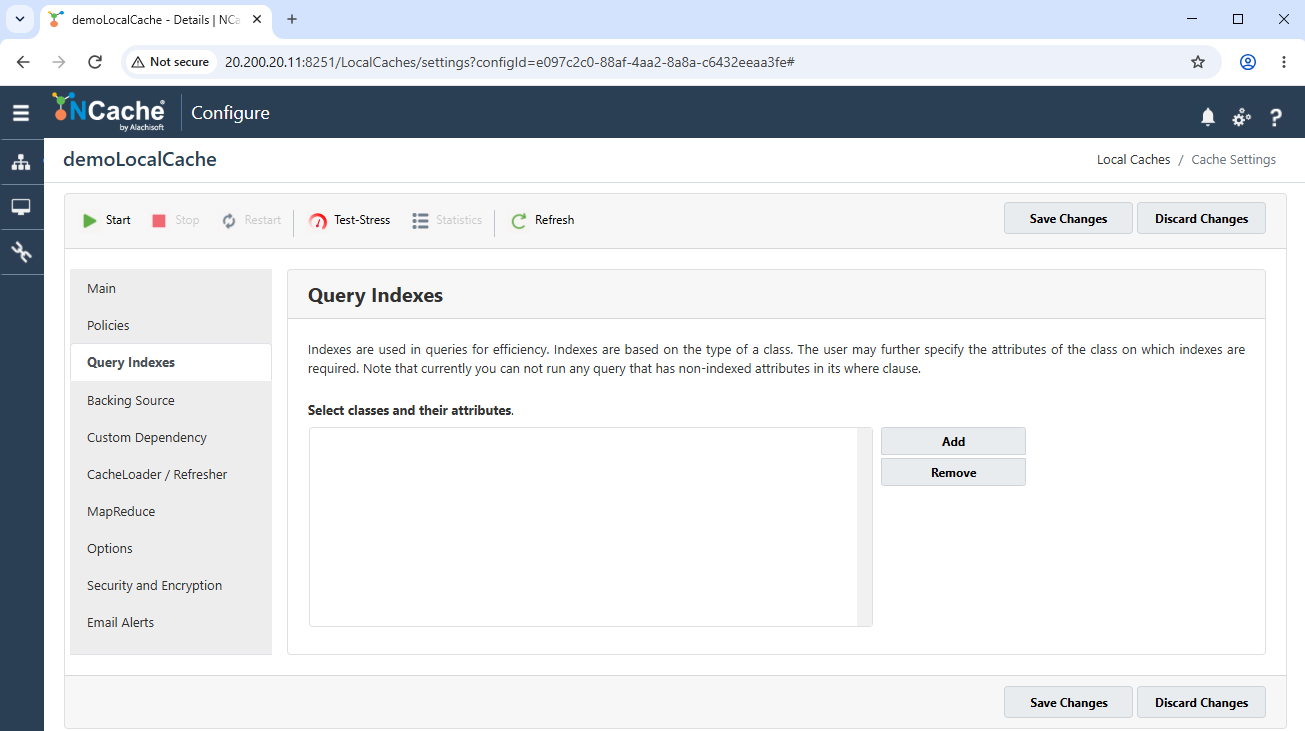
Configured classes and attributes are displayed in the main list.
The Add and Remove buttons allow query index entries to be added or removed.
Backing Source
The Backing Source page provides settings for integrating the local cache with an external data source through read-through and write-through providers.
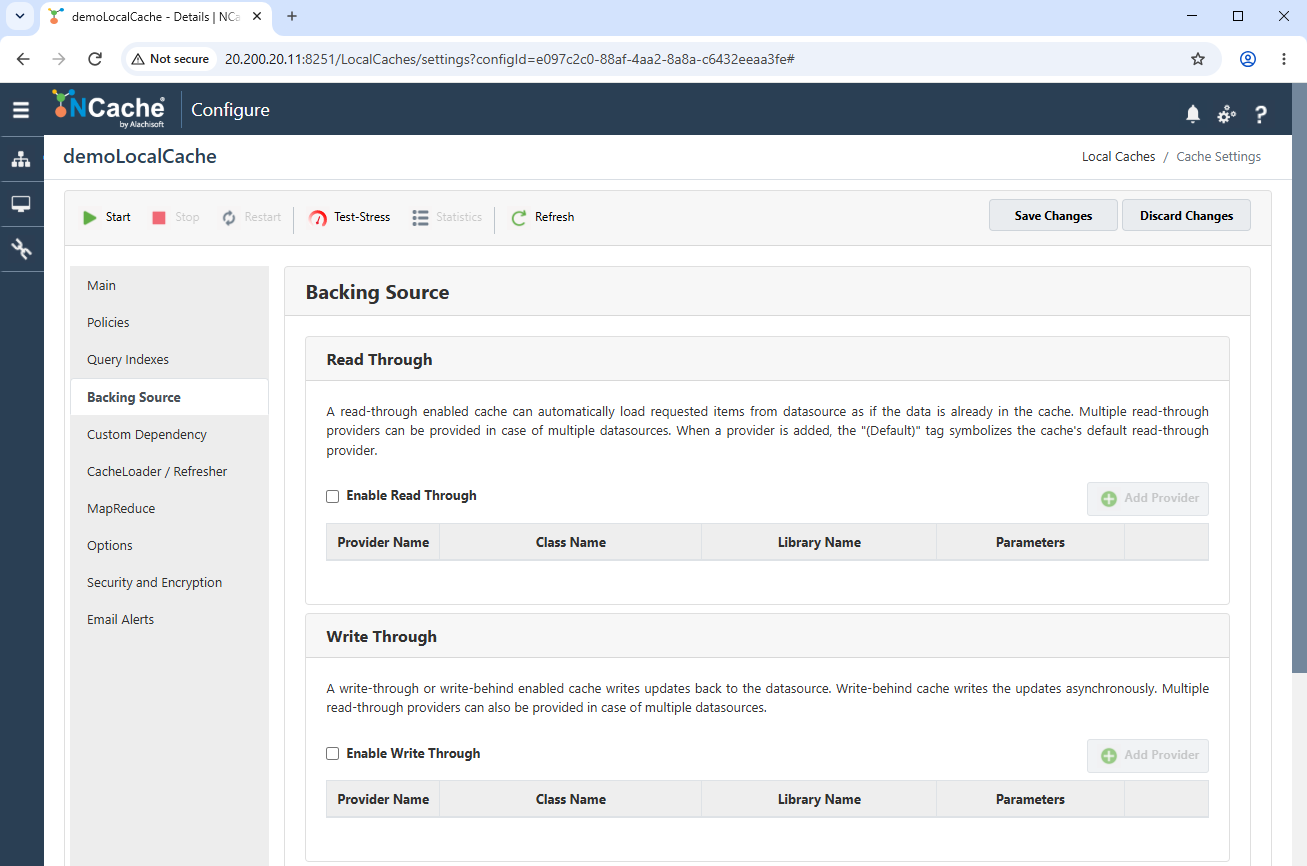
The Read Through section allows read-through to be enabled and providers to be added.
The Write Through section allows write-through to be enabled and providers to be added.
Provider entries display the provider name, class name, library name, and configured parameters.
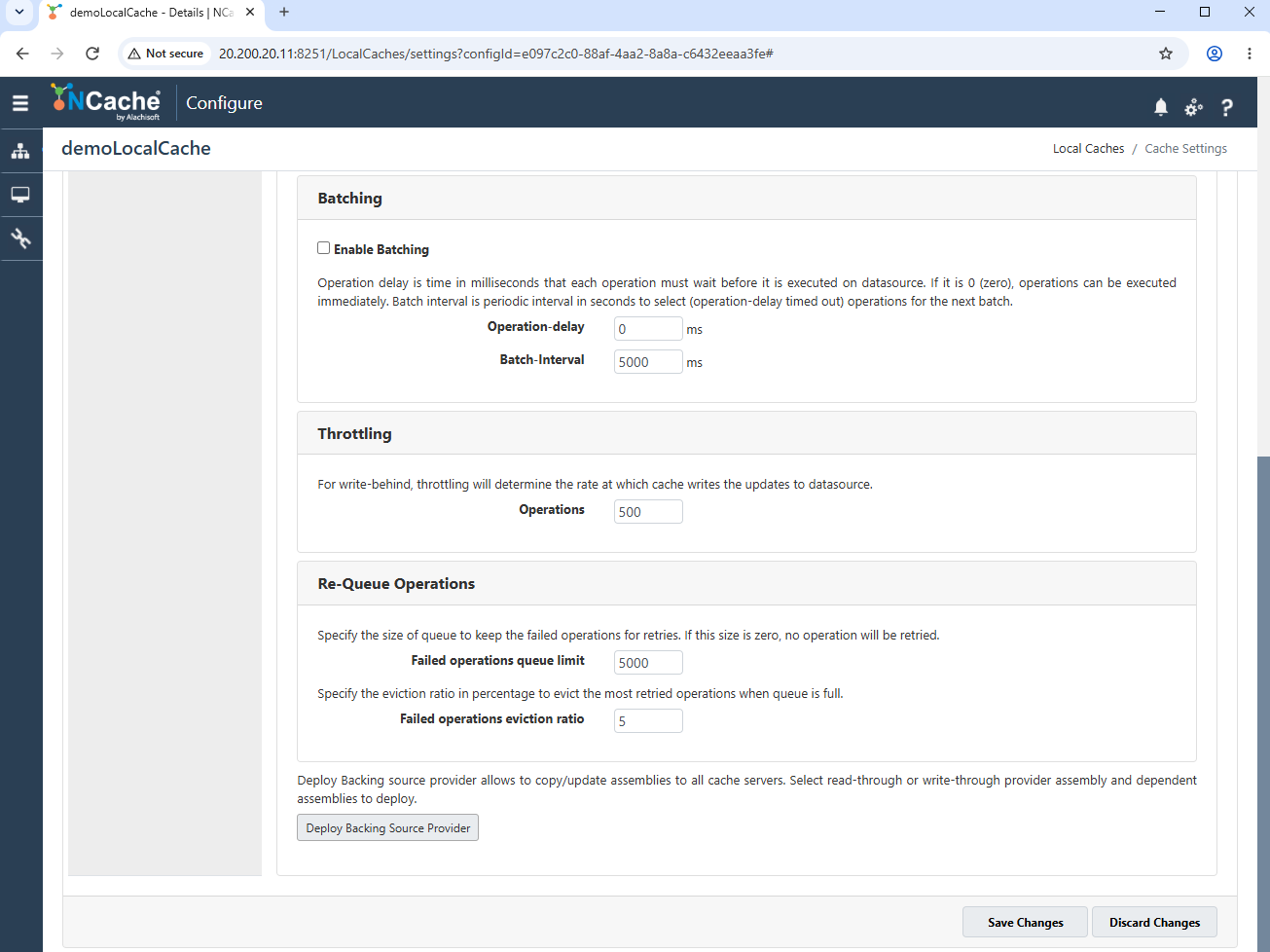
The Batching section allows batching to be enabled and provides the Operation-delay and Batch-Interval settings.
The Throttling section provides an Operations field for configuring the write-behind operation rate.
The Re-Queue Operations section provides the Failed operations queue limit and Failed operations eviction ratio settings.
The Deploy Backing Source Provider option is available for deploying provider assemblies and their dependent assemblies.
Cache Loader / Refresher
The Cache Loader / Refresher page provides settings for loading data when the cache starts and periodically refreshing configured datasets.
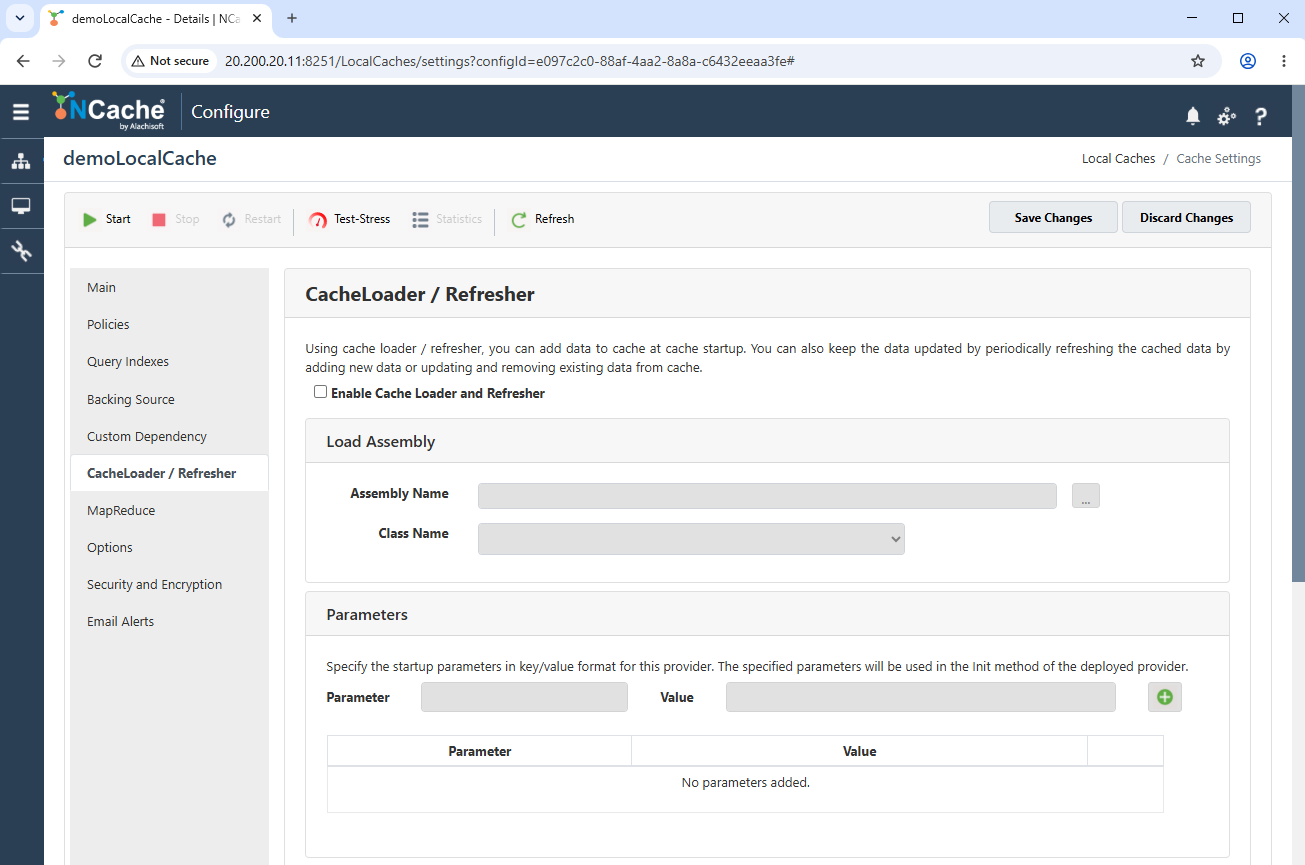
Select Enable Cache Loader and Refresher to enable the feature.
The Load Assembly section allows the provider assembly and implementing class to be selected.
The Parameters section allows startup parameters to be added as key-value pairs.
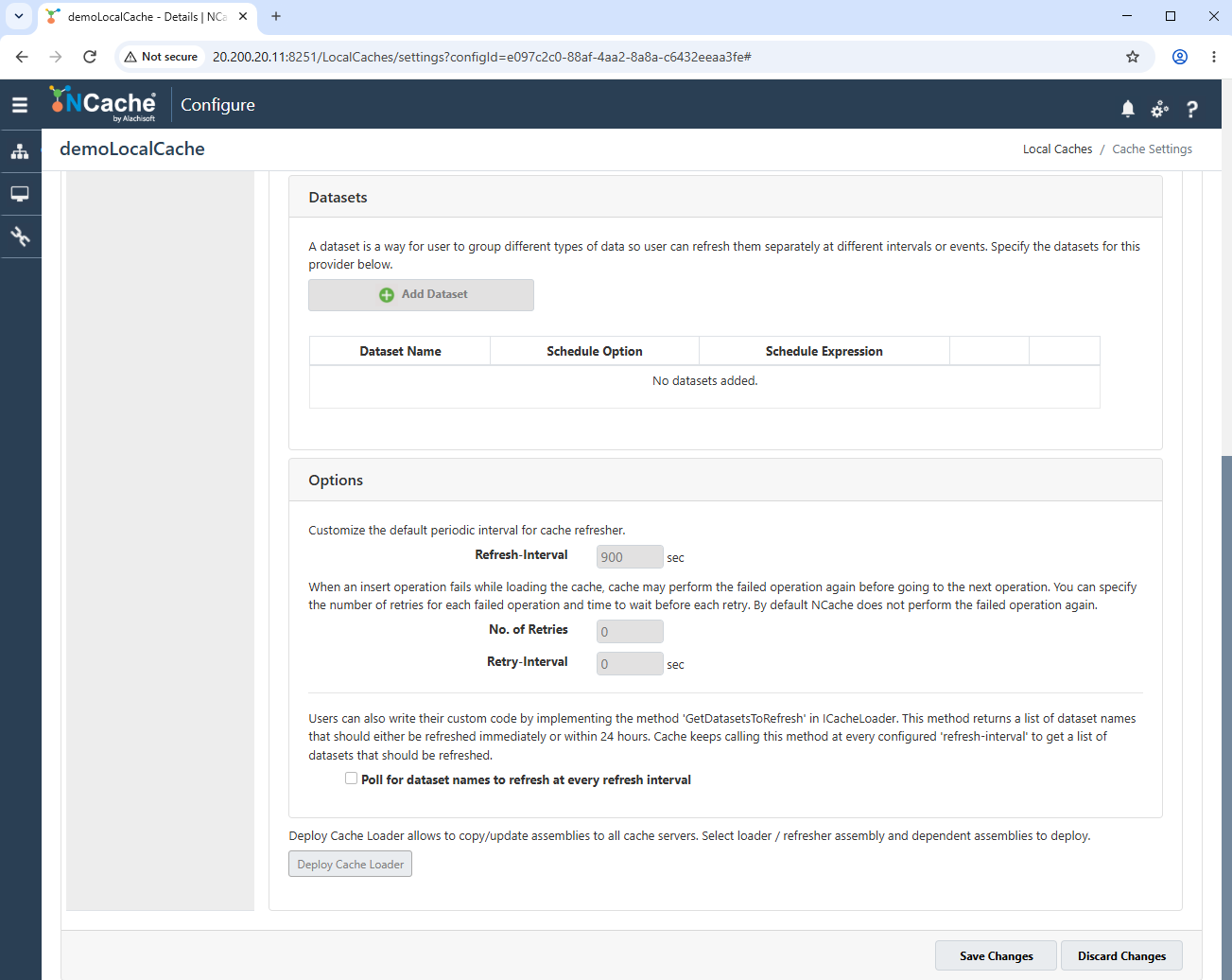
The Datasets section allows datasets and their scheduling information to be configured.
Refresh-Interval specifies the periodic interval used by the refresher.
No. of Retries and Retry-Interval configure the retry behavior for failed loading operations.
Poll for dataset names to refresh at every refresh interval controls whether the provider is queried for dataset names during each refresh interval.
The Deploy Cache Loader option is available for deploying the loader or refresher assembly and its dependencies.
Options
The Options page contains additional settings for notifications, logging, performance counters, compression, SQL notifications, and client activity notifications.
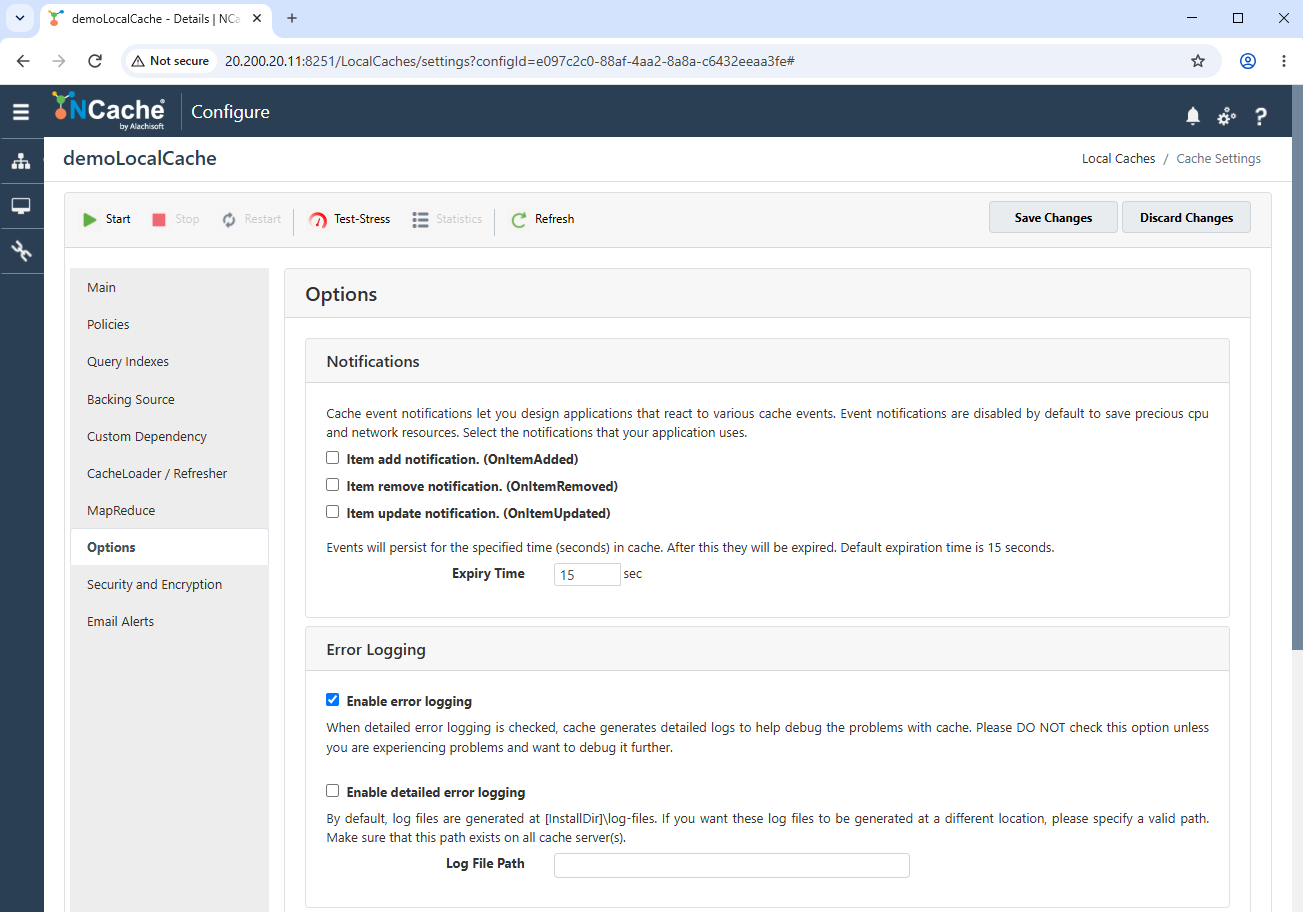
The Notifications section provides item-added, item-removed, and item-updated notification options.
Expiry Time specifies the expiration time for cache notifications and the interval after which items are checked for expiration.
The Error Logging section allows error logging and detailed error logging to be enabled.
Log File Path can be used to specify a location for cache log files.
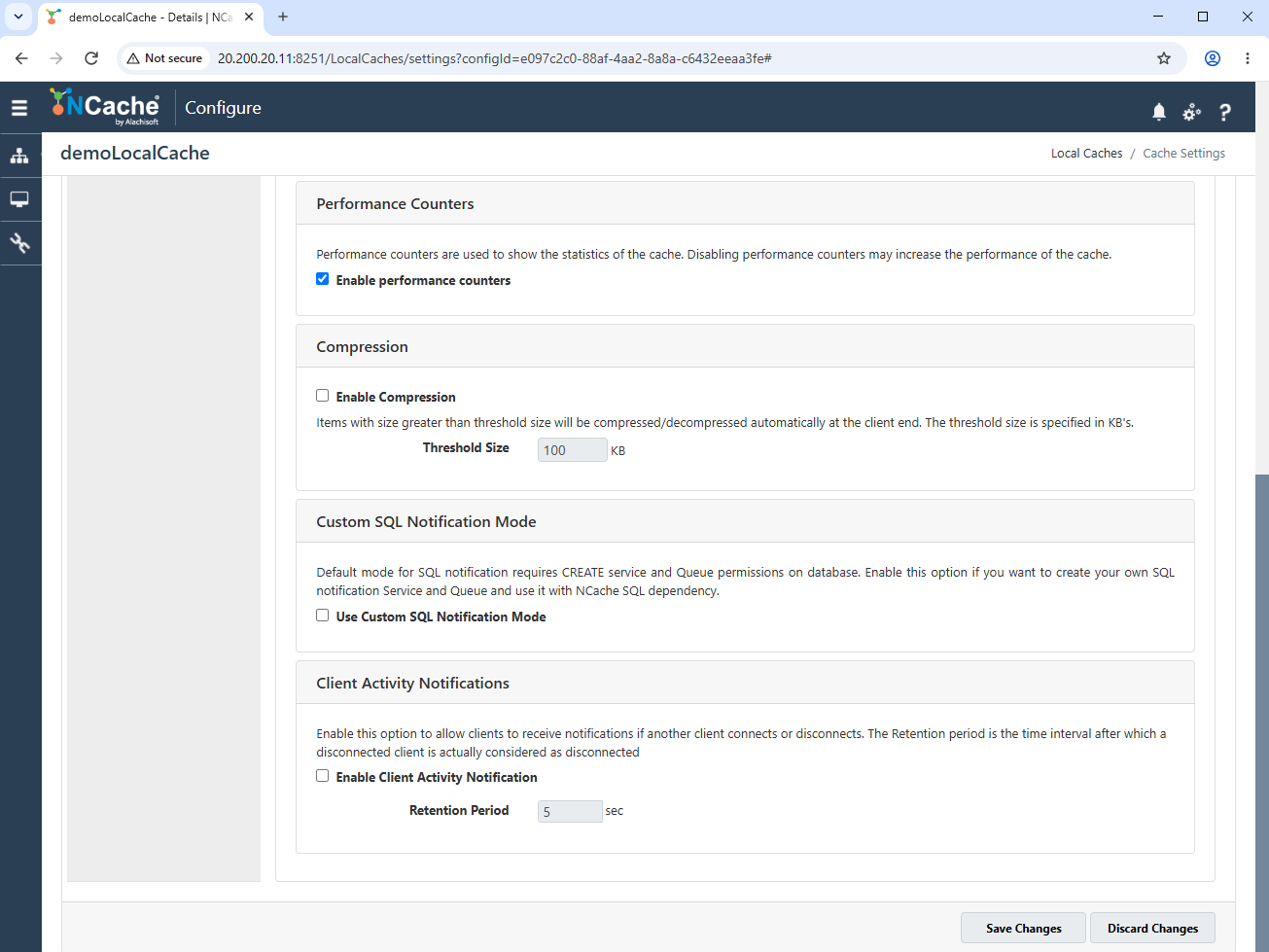
The Performance Counters section allows performance counters to be enabled or disabled.
The Compression section allows compression to be enabled and provides a Threshold Size in KB.
The Custom SQL Notification Mode section allows a custom SQL notification service and queue to be used with NCache SQL dependency.
The Client Activity Notifications section allows notifications for client connection and disconnection activity to be enabled.
Retention Period specifies the interval after which a disconnected client is treated as disconnected for notification purposes.
Security and Encryption
The Security and Encryption page provides authorization and encryption settings for the local cache.
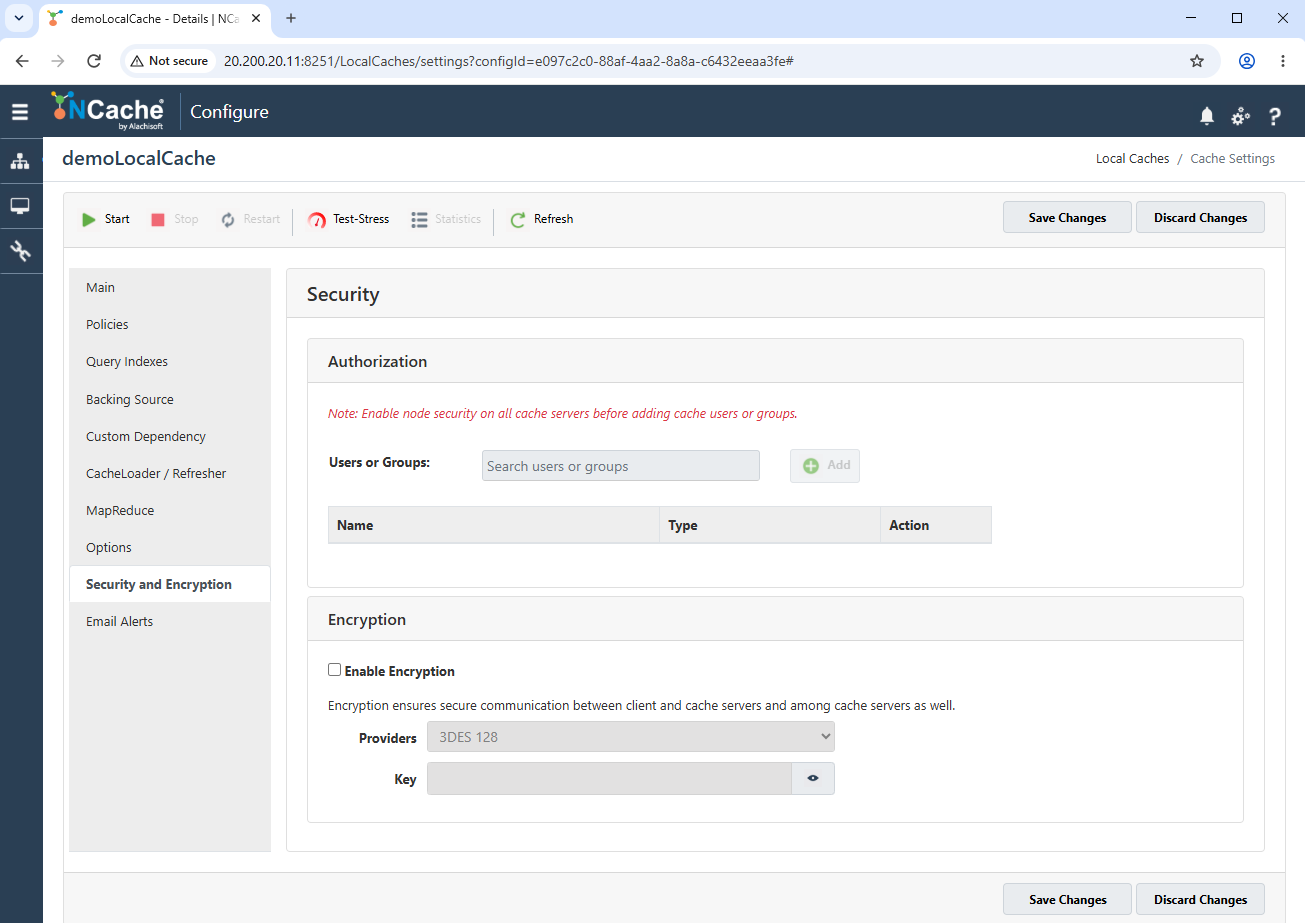
The Authorization section allows users or groups to be searched for and added to the cache authorization list.
Node security must be enabled before users or groups can be added.
The Encryption section allows encryption to be enabled and provides fields for selecting an encryption provider and entering its key.
Email Alerts
The Email Alerts page provides SMTP and recipient settings for sending notifications when selected local cache events occur.
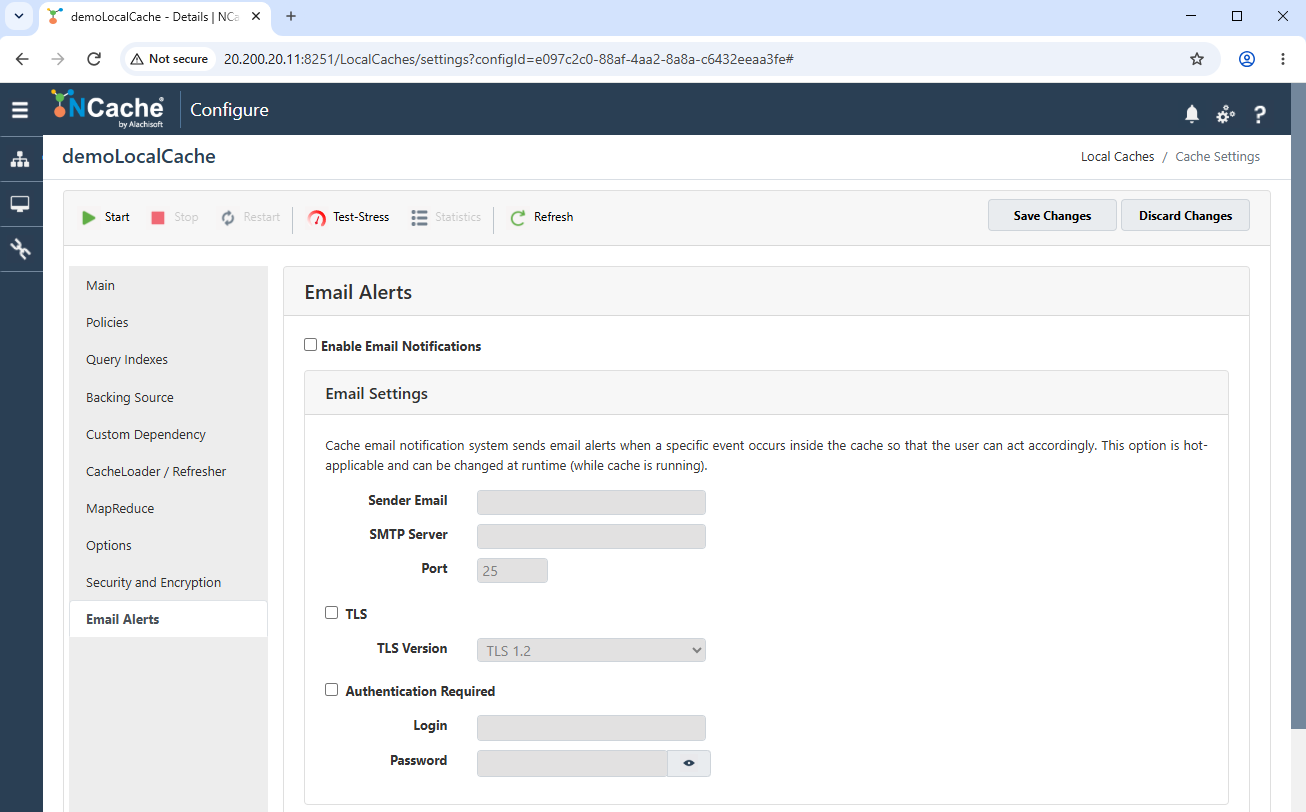
Select Enable Email Notifications to enable email alerts.
The Email Settings section contains fields for the sender email address, SMTP server, and port.
TLS can be enabled and a TLS Version can be selected.
SMTP authentication can be enabled by providing a login and password.
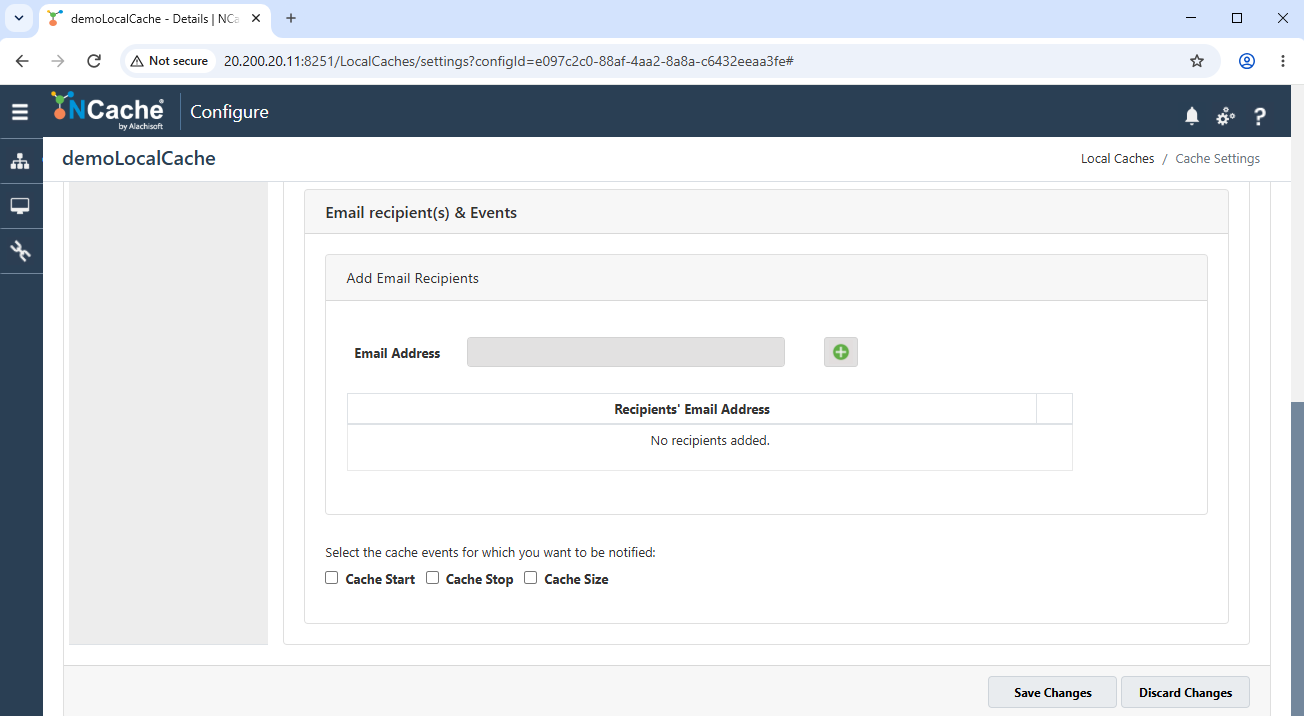
The Email recipient(s) & Events section allows recipient email addresses to be added and displays the configured recipients.
Notifications can be selected for the available events, including Cache Start, Cache Stop, and Cache Size.
The Save Changes and Discard Changes buttons are available on the configuration page to apply or revert modifications.
