Clustered Cache Configuration
The Clustered Cache Configuration page in NCache Management Center displays the configuration details of a selected clustered cache. This view is opened by clicking View Details on a cache from the Clustered Caches page.
Overview
The Overview section provides a high-level summary of the selected clustered cache and its current configuration. It gives quick visibility into important cache properties and operational settings.
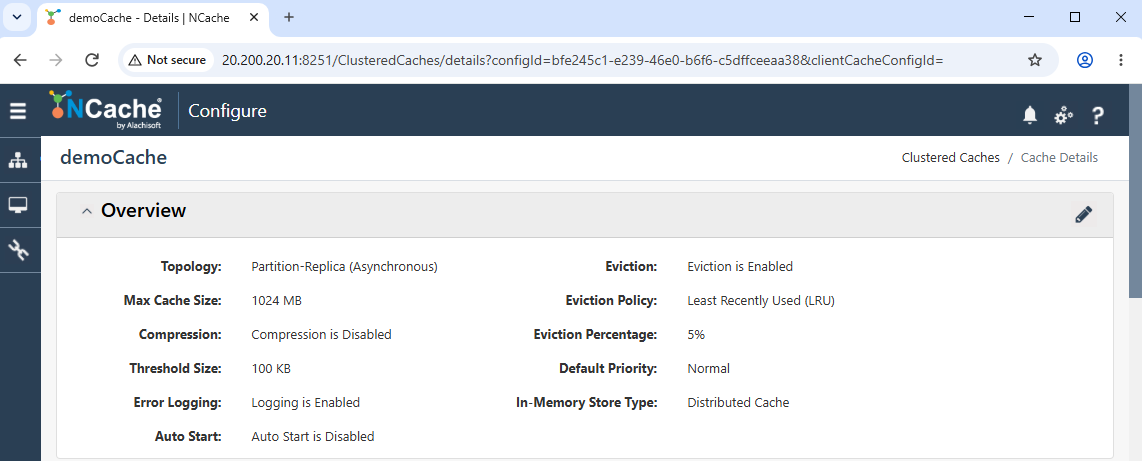
It displays key information such as the configured Topology (e.g., Partition-Replica), Max Cache Size, and whether Compression is enabled. It also shows the configured Threshold Size, Error Logging status, and Auto Start setting.
Eviction-related details are also shown, including whether eviction is enabled, the selected Eviction Policy (e.g., LRU), Eviction Percentage, and Default Priority. The In-Memory Store Type is also listed.
Server Nodes
The Server Nodes section displays all cache server nodes participating in the cluster. It also provides controls to manage node-level operations and monitor their status.
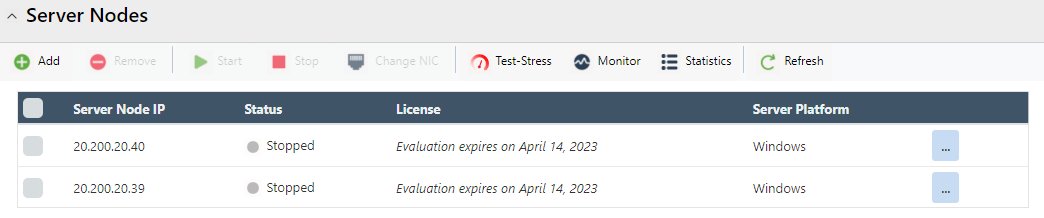
Each node entry displays the Server Node IP, its Status (e.g., Running, Stopped), license information, and the Server Platform.
The toolbar in this section provides options to manage nodes, including adding or removing nodes, starting or stopping the cache on selected nodes, changing NIC settings, running Test-Stress, opening Monitor, viewing Statistics, and refreshing the node list.
Each node row also provides a More Options (⋯) menu for additional actions.
Client Nodes
The Client Nodes section shows all client nodes configured for the cache and allows management of client connectivity. It helps track the client nodes configured to use the cache.
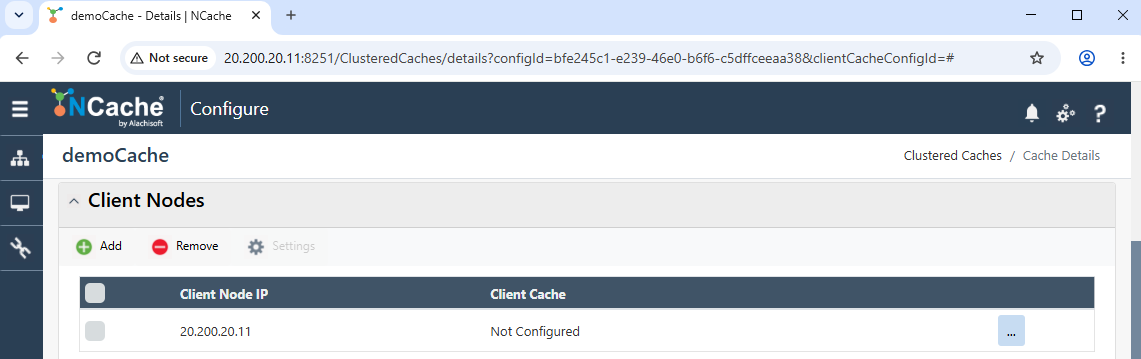
It displays the Client Node IP along with the associated Client Cache (if configured).
Options are available to add or remove client nodes, while additional configuration settings can be accessed through the Settings option.
Client Cache
The Client Cache section displays the client cache configured for the selected clustered cache. It provides separate pages for reviewing and modifying the main client cache settings, additional options, and email alerts.
Main
The Main page contains the primary configuration settings for the client cache.
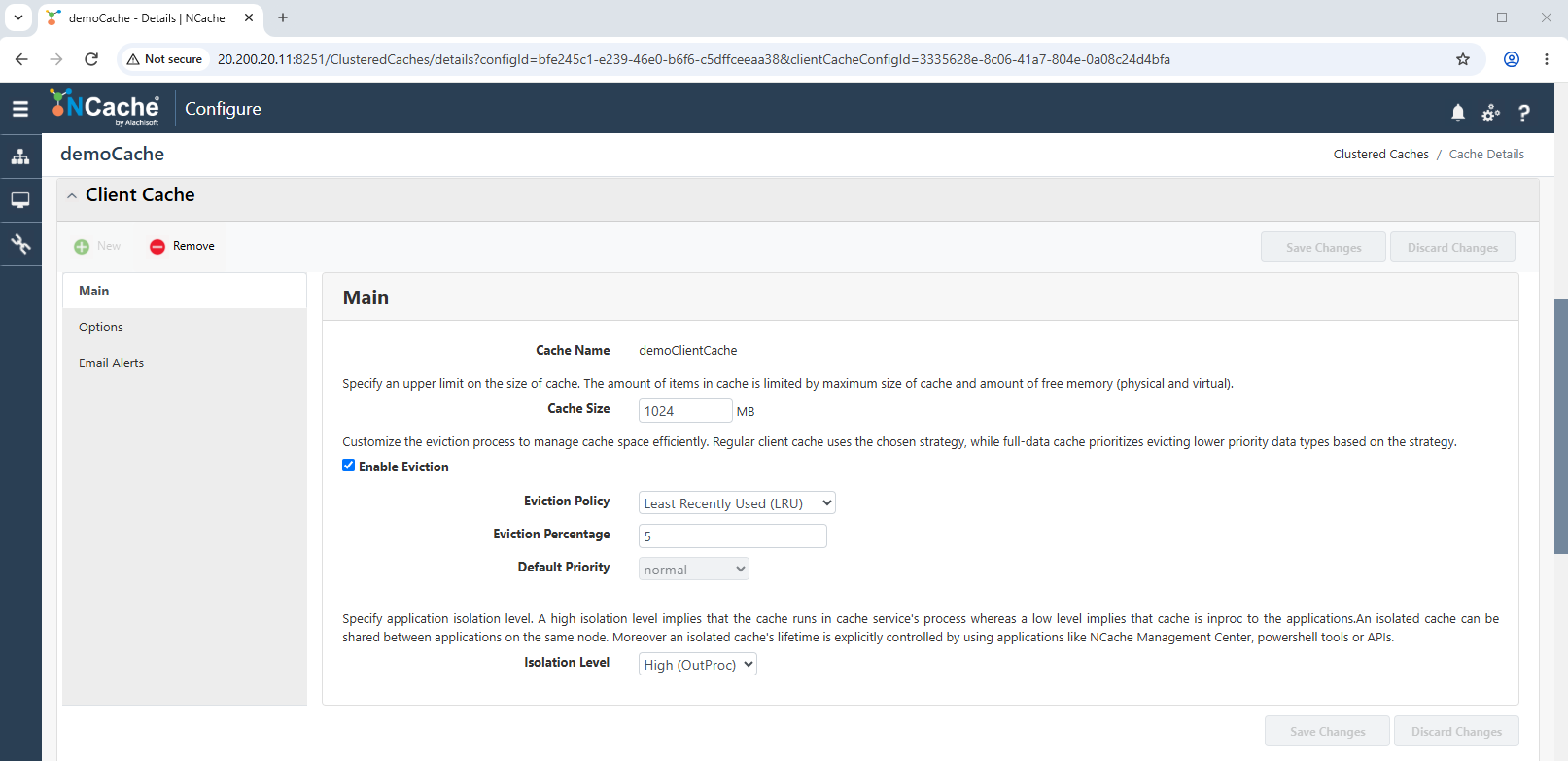
It displays the client cache name and allows you to specify the maximum Cache Size in MB.
Eviction can be enabled and configured by selecting an Eviction Policy and specifying the Eviction Percentage. The Default Priority field is also displayed where applicable.
The Isolation Level option specifies whether the client cache runs in a separate process or within the application process.
Options
The Options page contains additional settings related to logging, performance counters, compression, SQL dependency, and client cache synchronization.
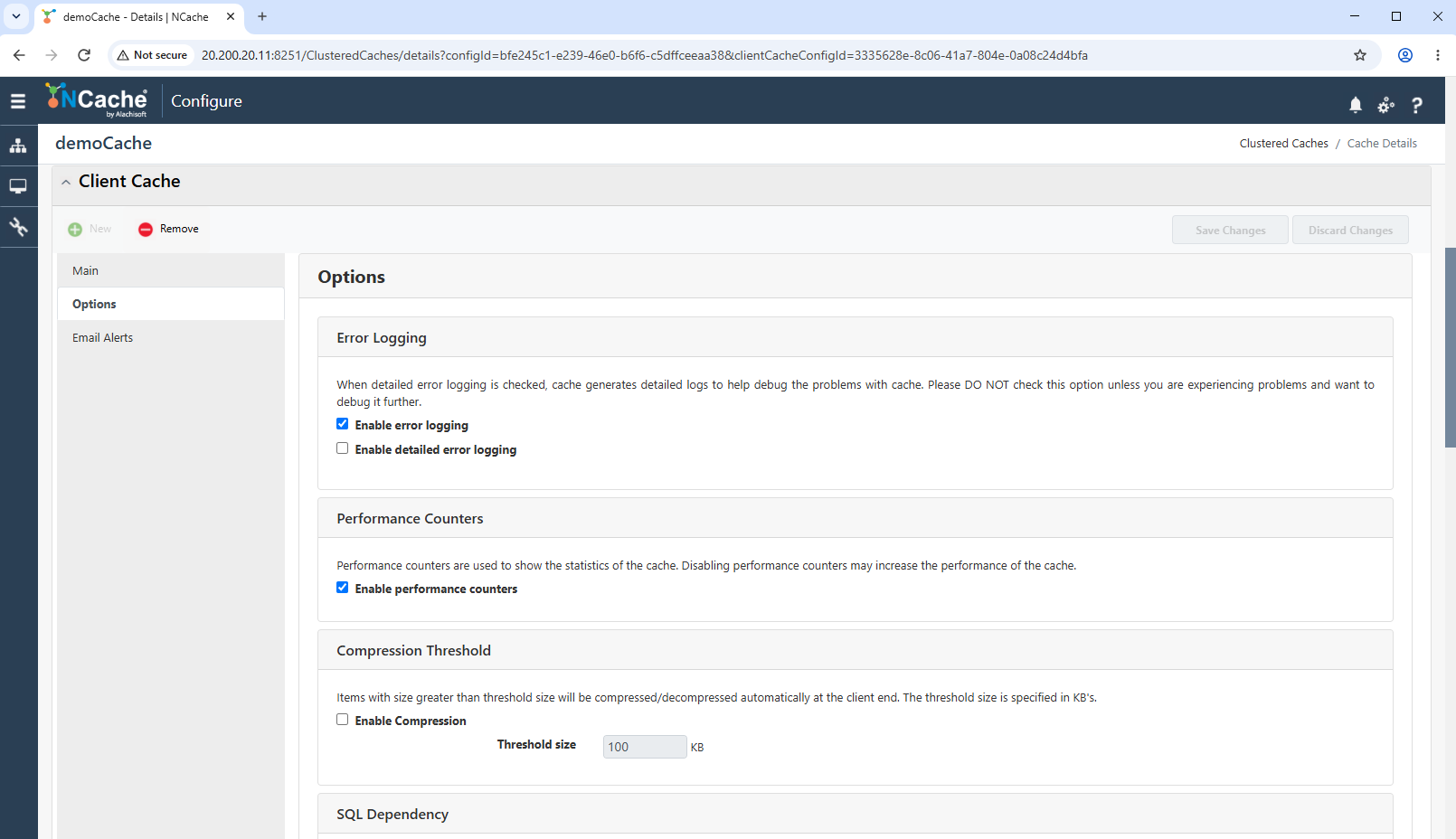
Error Logging provides options to enable error logging and detailed error logging for the client cache.
Performance Counters allows performance counter collection to be enabled or disabled.
Compression Threshold provides an option to enable compression and specify the threshold size in KB.
SQL Dependency provides the Use Custom SQL Notification Mode option for environments that use a custom SQL notification service and queue.
Synchronization allows you to specify the Client Polling Interval. This interval determines how frequently the client cache polls the clustered cache for changes when synchronizing cached data.
Email Alerts
The Email Alerts page provides settings for sending email notifications for selected client cache events.
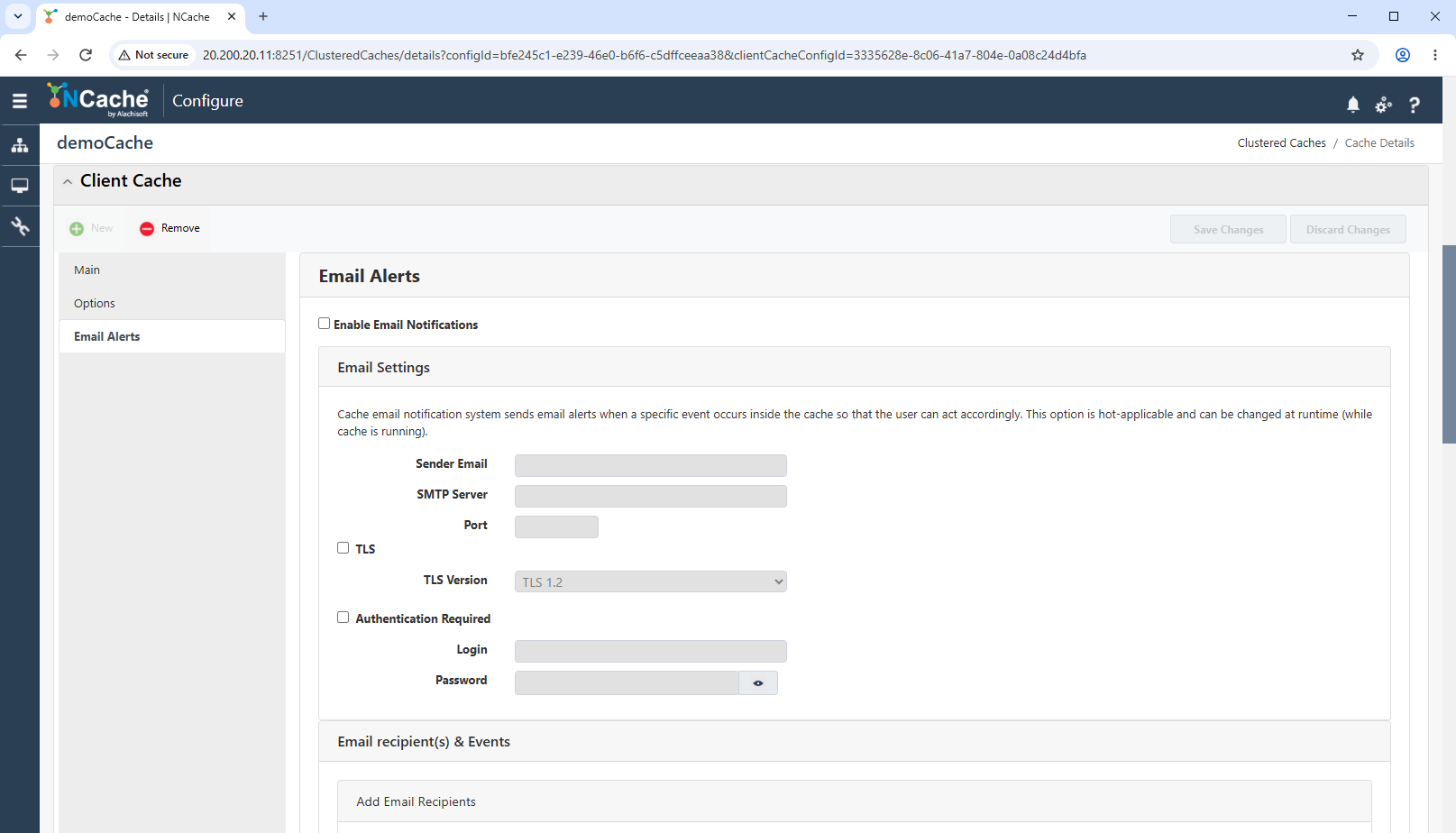
Email notifications can be enabled by selecting Enable Email Notifications.
The Email Settings section contains fields for the sender email address, SMTP server, port, TLS configuration, and authentication credentials.
The Email recipient(s) & Events section allows recipient email addresses to be added and displays the configured recipients.
Notifications can be selected for the available events, including Cache Start, Cache Stop, and Cache Size.
Advanced Settings (Clustered Cache)
The Advanced Settings (Clustered Cache) section provides configuration pages for cluster communication, expiration, data balancing, data-source integration, notifications, security, and other cache settings. Select a category from the navigation panel to view and modify its available options.
Cluster Settings
The Cluster Settings page contains communication, connection, replication, and split-brain settings for the clustered cache.
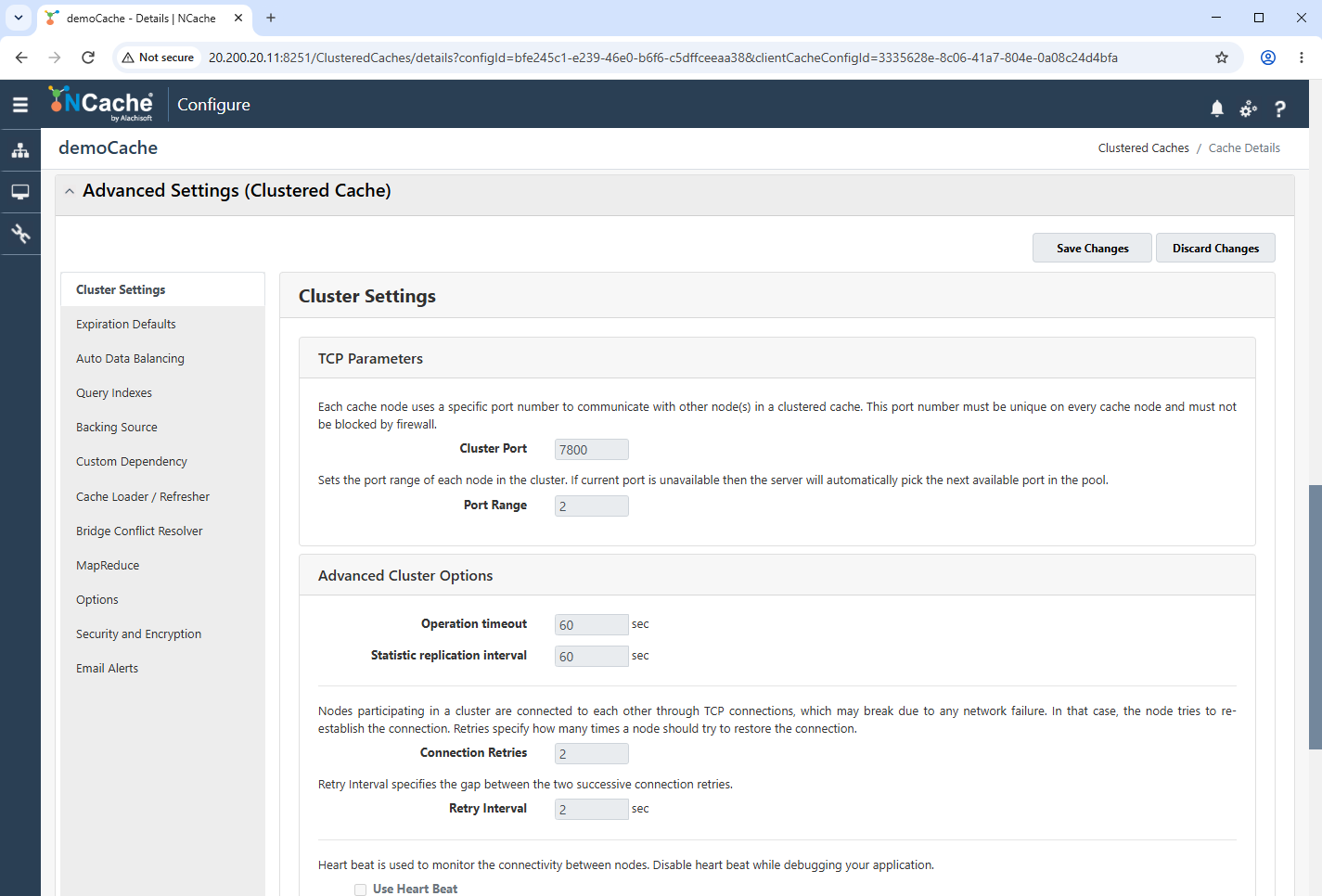
The TCP Parameters section displays the Cluster Port used by cache nodes and the Port Range available when the configured port is unavailable.
The Advanced Cluster Options section provides fields for the Operation Timeout, Statistic Replication Interval, Connection Retries, and Retry Interval.
The Use Heart Beat option controls whether heartbeat messages are used to monitor connectivity between cache nodes.
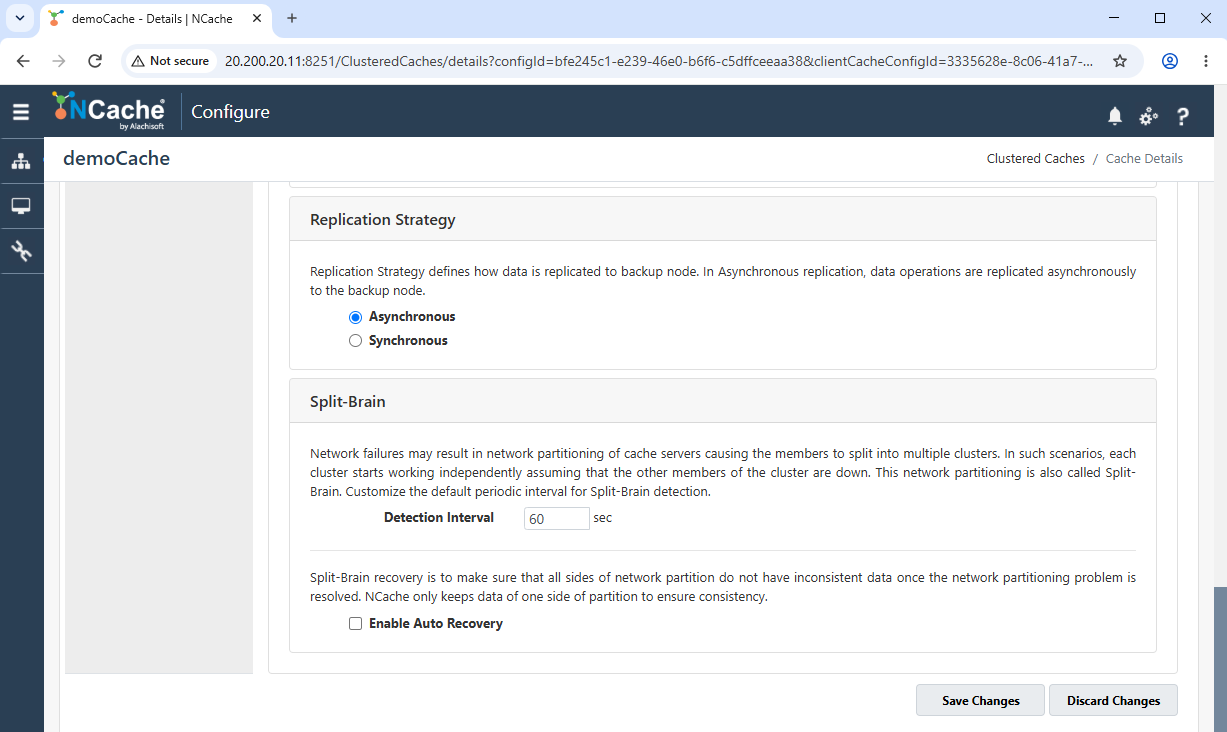
Where applicable, the Replication Strategy section allows replication to be configured as Asynchronous or Synchronous.
The Split-Brain section provides a Detection Interval and an Enable Auto Recovery option for handling network-partition scenarios.
Expiration Defaults
The Expiration Defaults page defines cache-level expiration values that can be applied when an item is added without an explicit expiration.
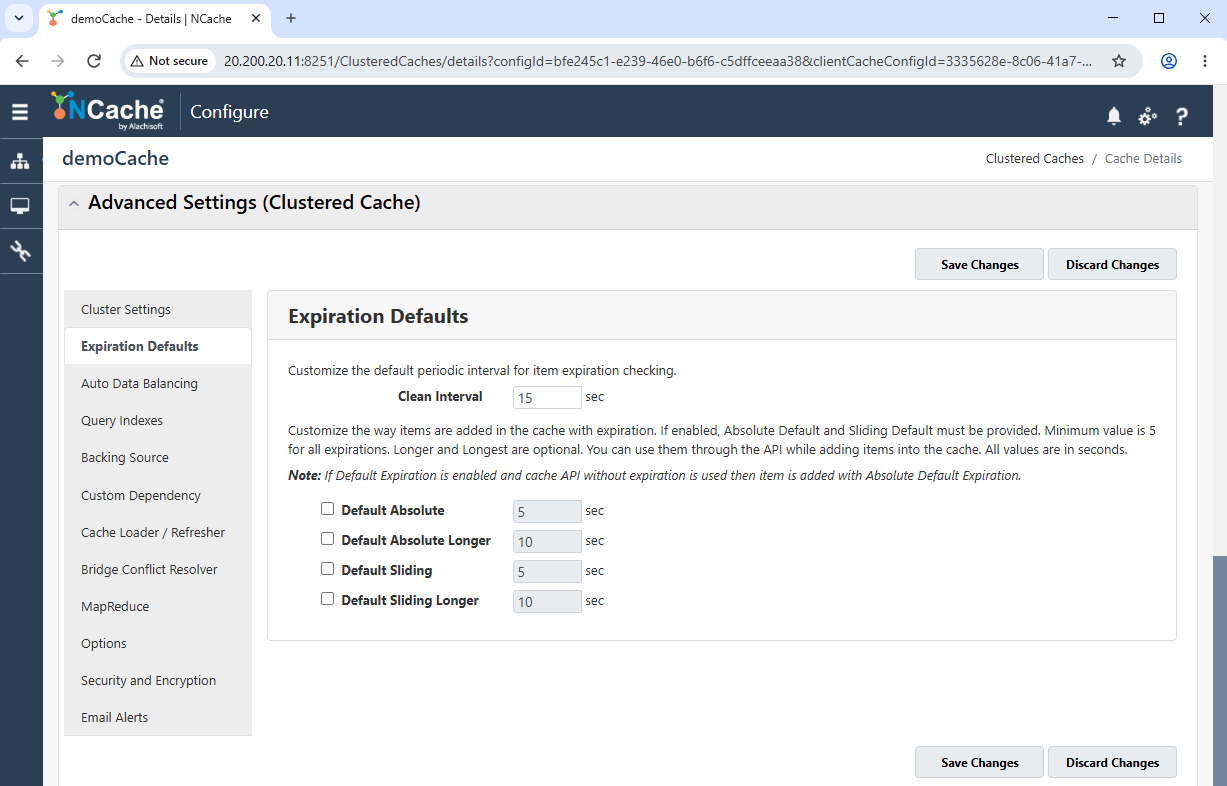
Clean Interval specifies how frequently the cache checks for expired items.
Default expiration can be enabled for Default Absolute, Default Absolute Longer, Default Sliding, and Default Sliding Longer.
A duration in seconds can be specified for each enabled expiration option.
Auto Data Balancing
The Auto Data Balancing page provides settings for periodically checking and balancing the distribution of cached data across cluster nodes.
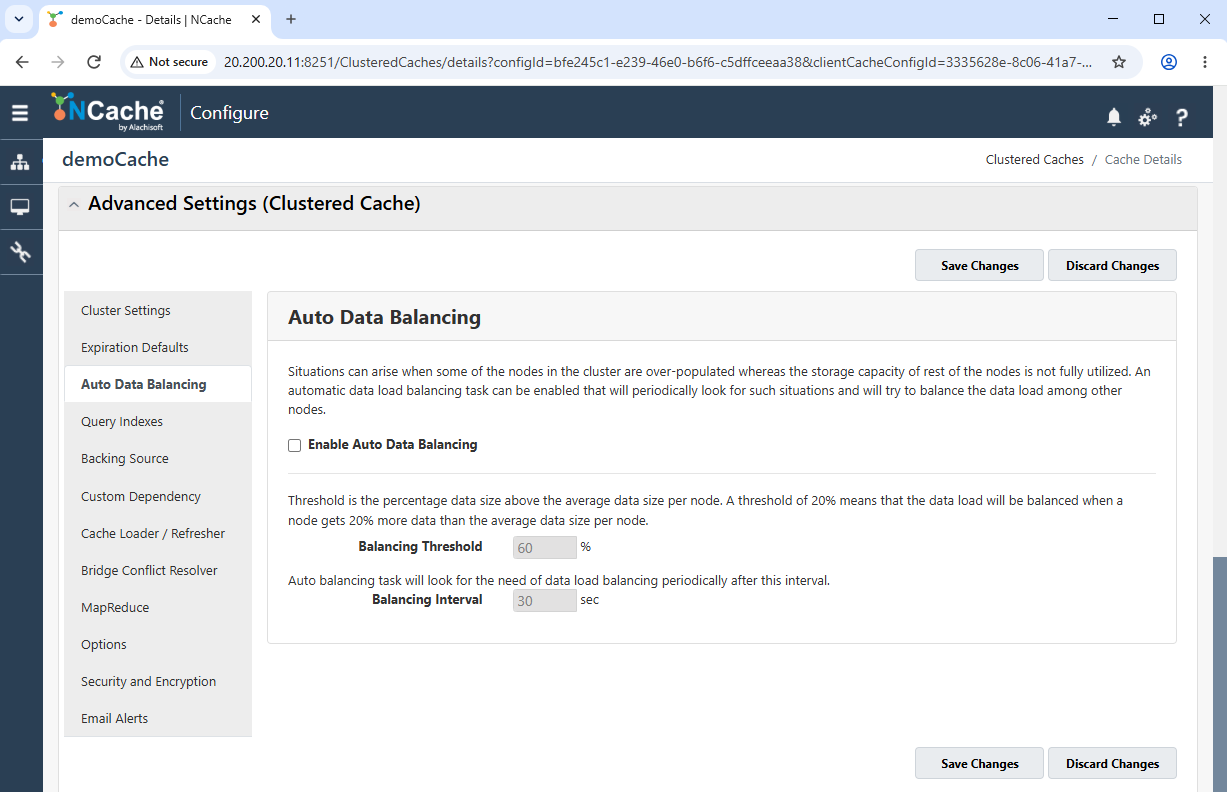
Select Enable Auto Data Balancing to enable the feature.
Balancing Threshold specifies the percentage above the average data size per node at which balancing is considered.
Balancing Interval specifies how frequently the cache checks whether data balancing is required.
Query Indexes
The Query Indexes page allows classes and their attributes to be configured for indexing.
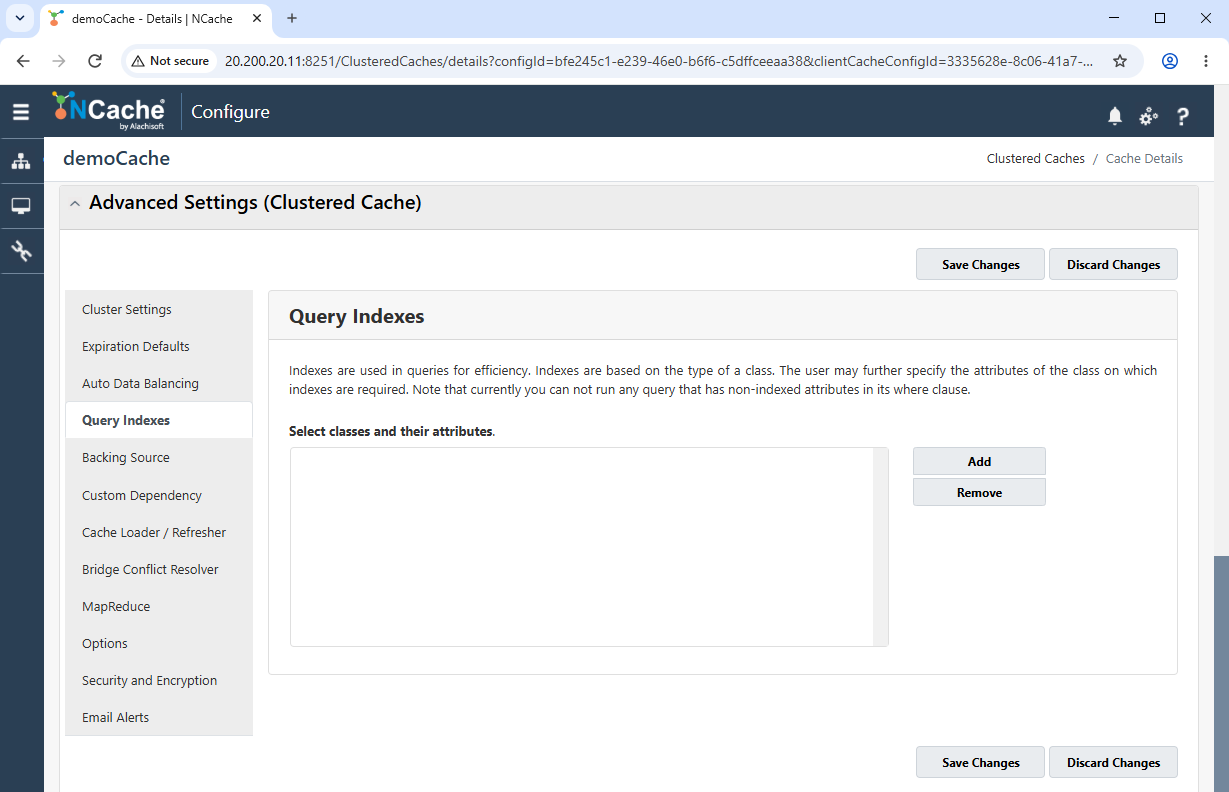
The configured classes and attributes are displayed in the main list.
The Add and Remove buttons allow index entries to be added or removed.
Backing Source
The Backing Source page provides settings for integrating the cache with external data sources through read-through and write-through providers.
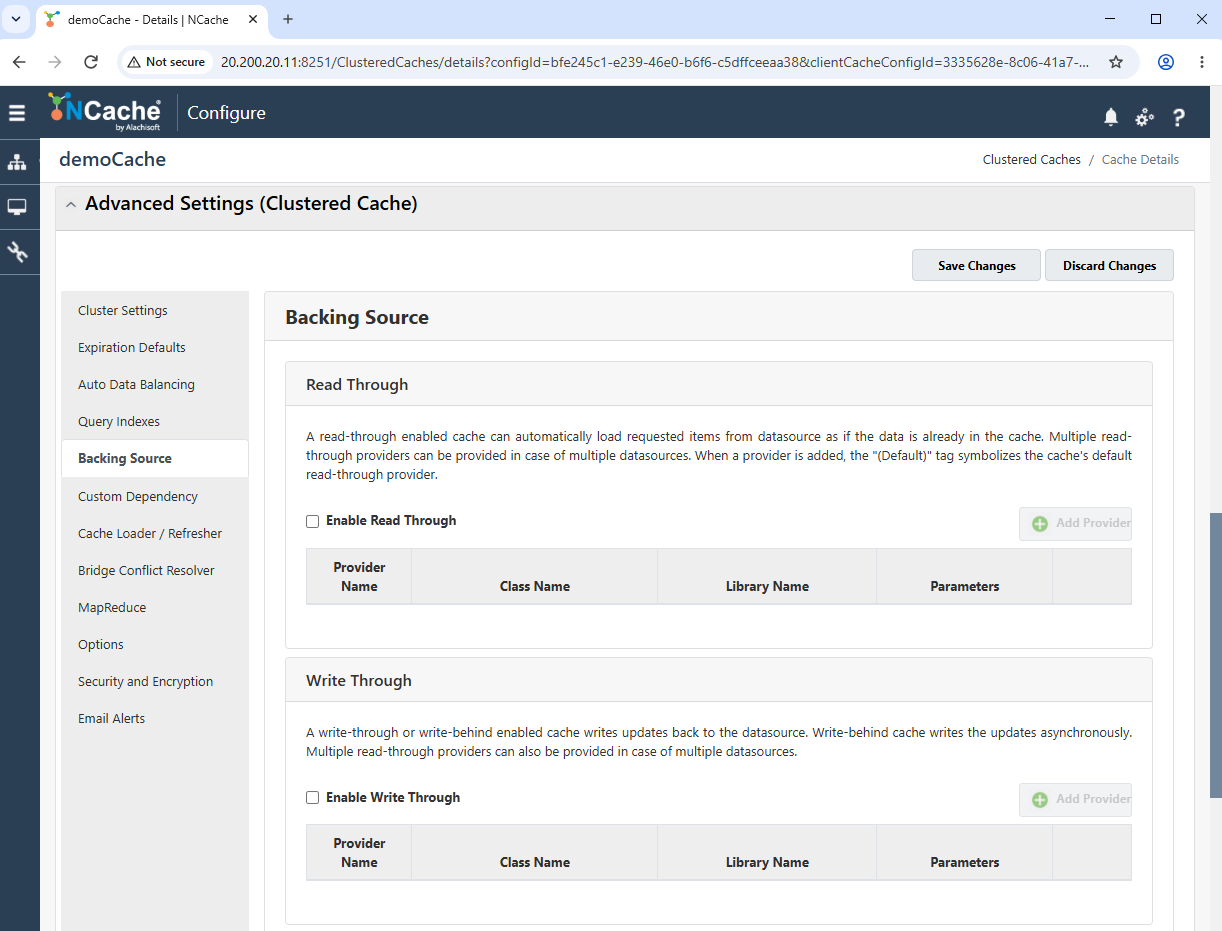
The Read Through section allows read-through to be enabled and providers to be added.
The Write Through section allows write-through to be enabled and providers to be added.
Provider entries display information such as the provider name, class name, library name, and parameters.
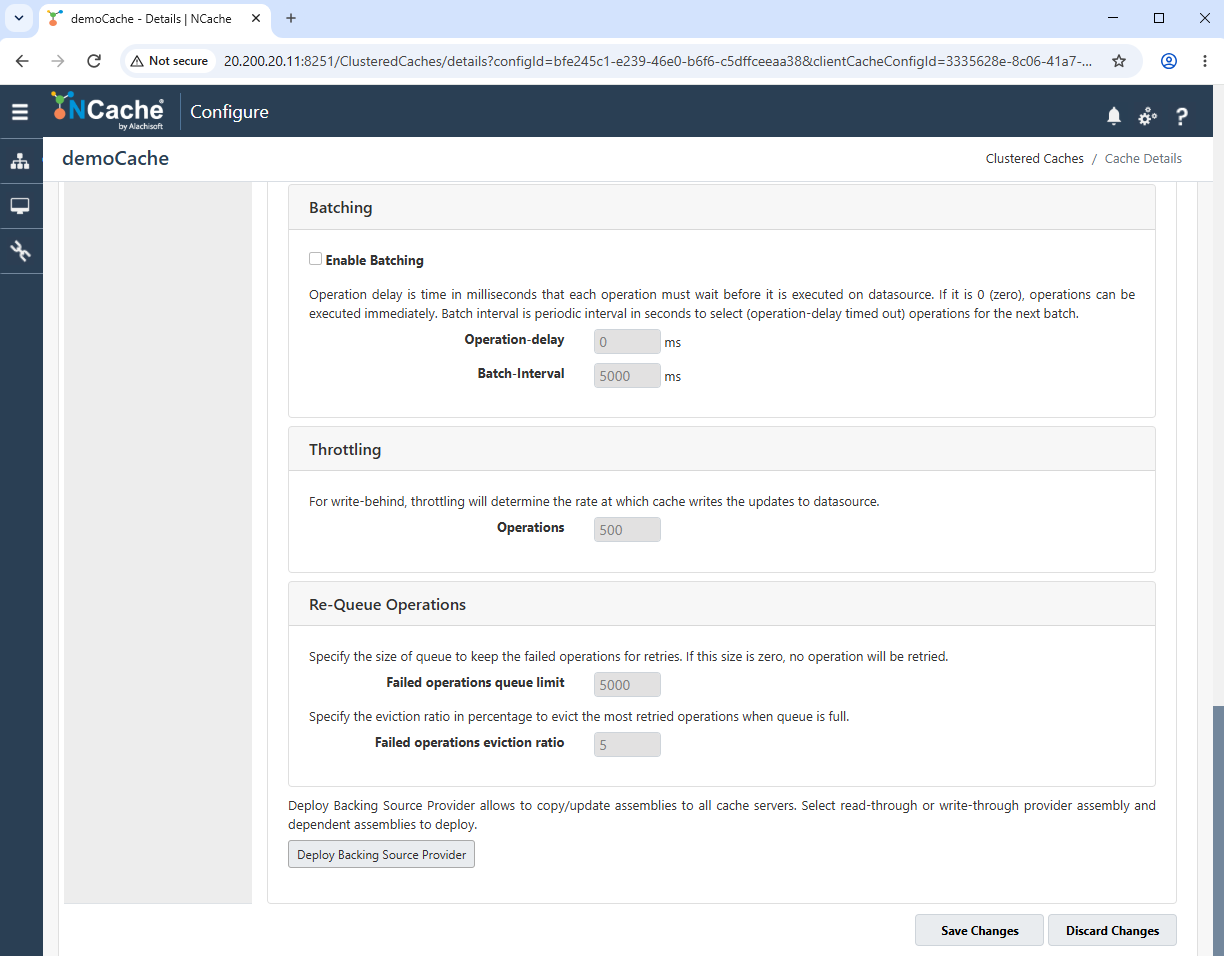
The Batching section provides settings for enabling batching and specifying the Operation-delay and Batch-Interval.
The Throttling section provides an Operations field for controlling the write-behind operation rate.
The Re-Queue Operations section provides the Failed operations queue limit and Failed operations eviction ratio settings.
The Deploy Backing Source Provider option is available for deploying the selected provider assemblies and their dependencies to cache servers.
Cache Loader / Refresher
The Cache Loader / Refresher page provides settings for loading data when the cache starts and refreshing configured datasets.
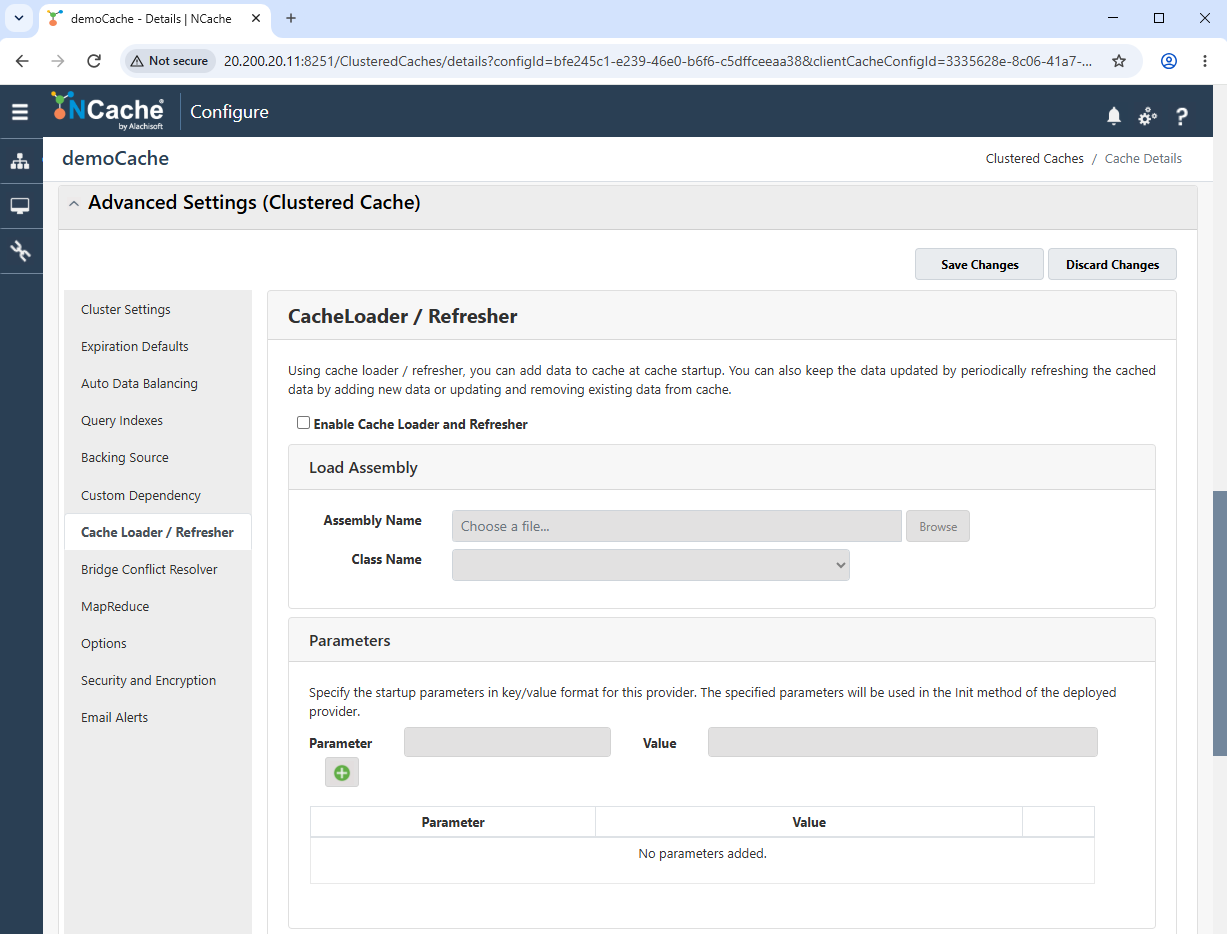
Select Enable Cache Loader and Refresher to enable the feature.
The Load Assembly section allows an assembly to be selected and its implementing class to be specified.
Startup parameters can be added as key-value pairs.
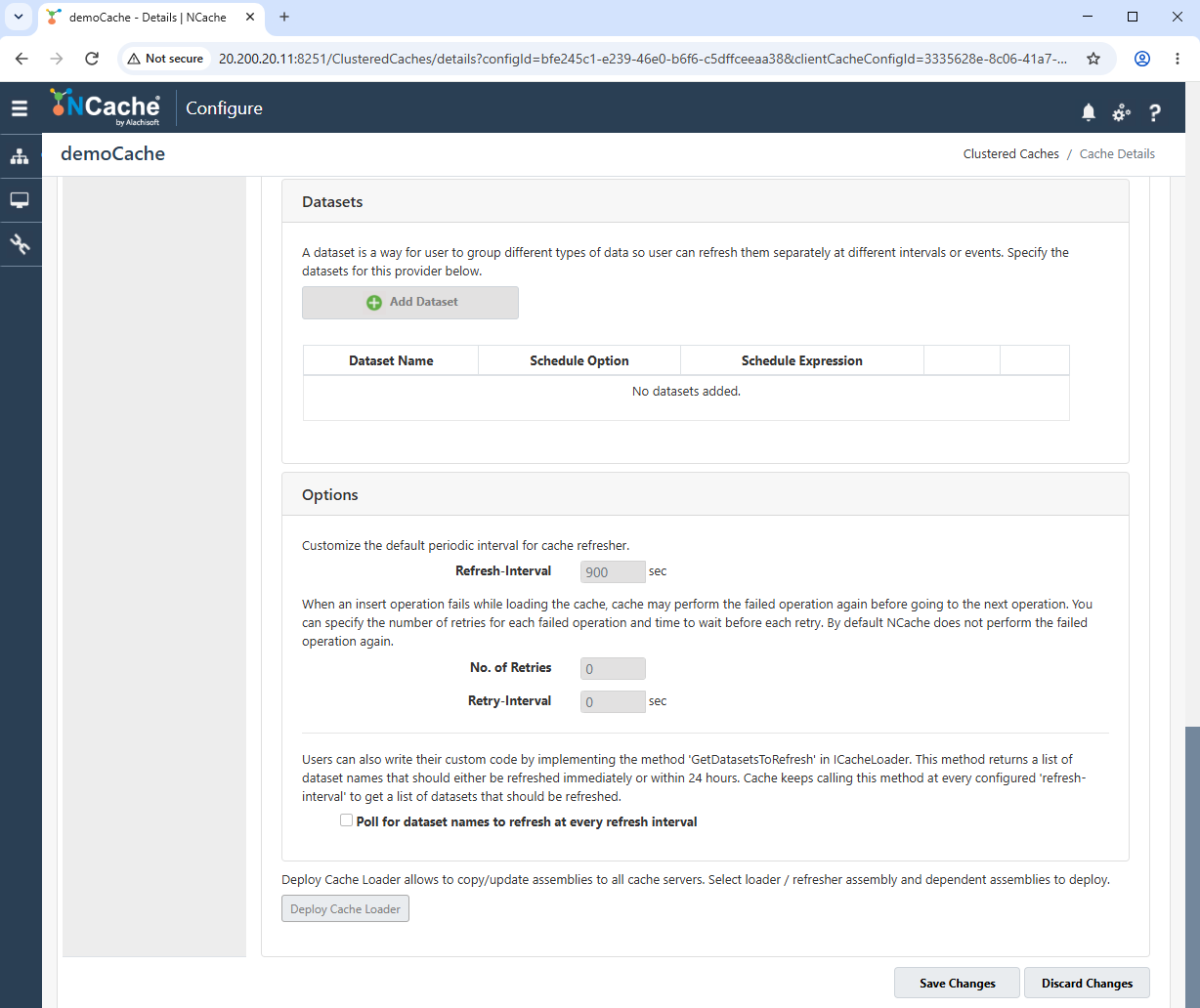
The Datasets section allows datasets and their scheduling information to be configured.
Refresh-Interval specifies the periodic interval used by the refresher.
No. of Retries and Retry-Interval configure retry behavior for failed loading operations.
The Poll for dataset names to refresh at every refresh interval option controls whether dataset names are requested from the provider during each refresh interval.
The Deploy Cache Loader option is available for deploying the loader or refresher assembly and its dependencies to cache servers.
Bridge Conflict Resolver
The Bridge Conflict Resolver page provides settings for configuring a custom conflict resolver for operations replicated from a bridge.
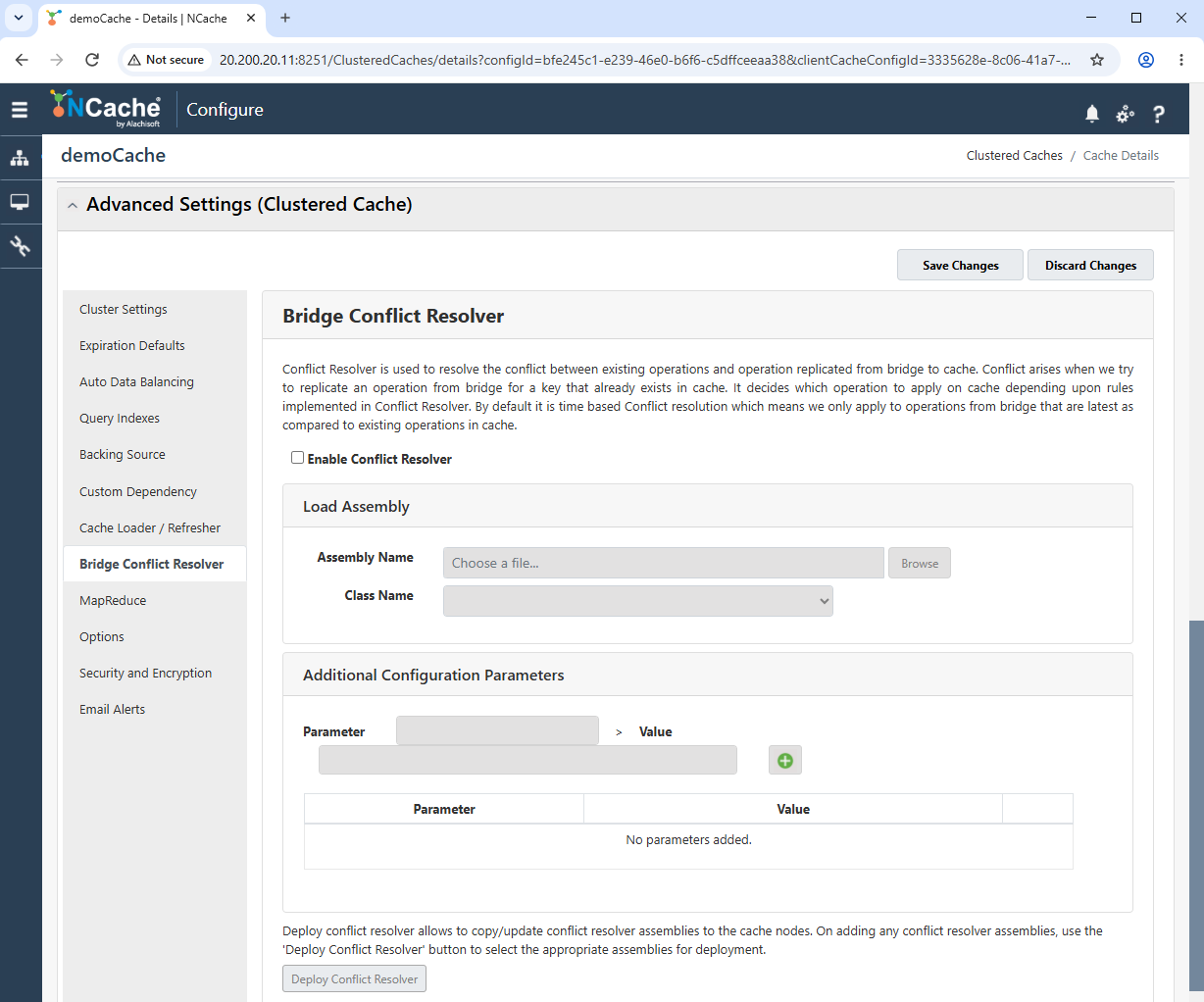
Select Enable Conflict Resolver to enable the configured resolver.
The Load Assembly section allows the resolver assembly and implementing class to be selected.
Additional configuration parameters can be supplied as key-value pairs.
The Deploy Conflict Resolver option is available for deploying the resolver assembly to cache nodes.
Options
The Options page contains settings for cache notifications, logging, performance counters, SQL notification mode, and client activity notifications.
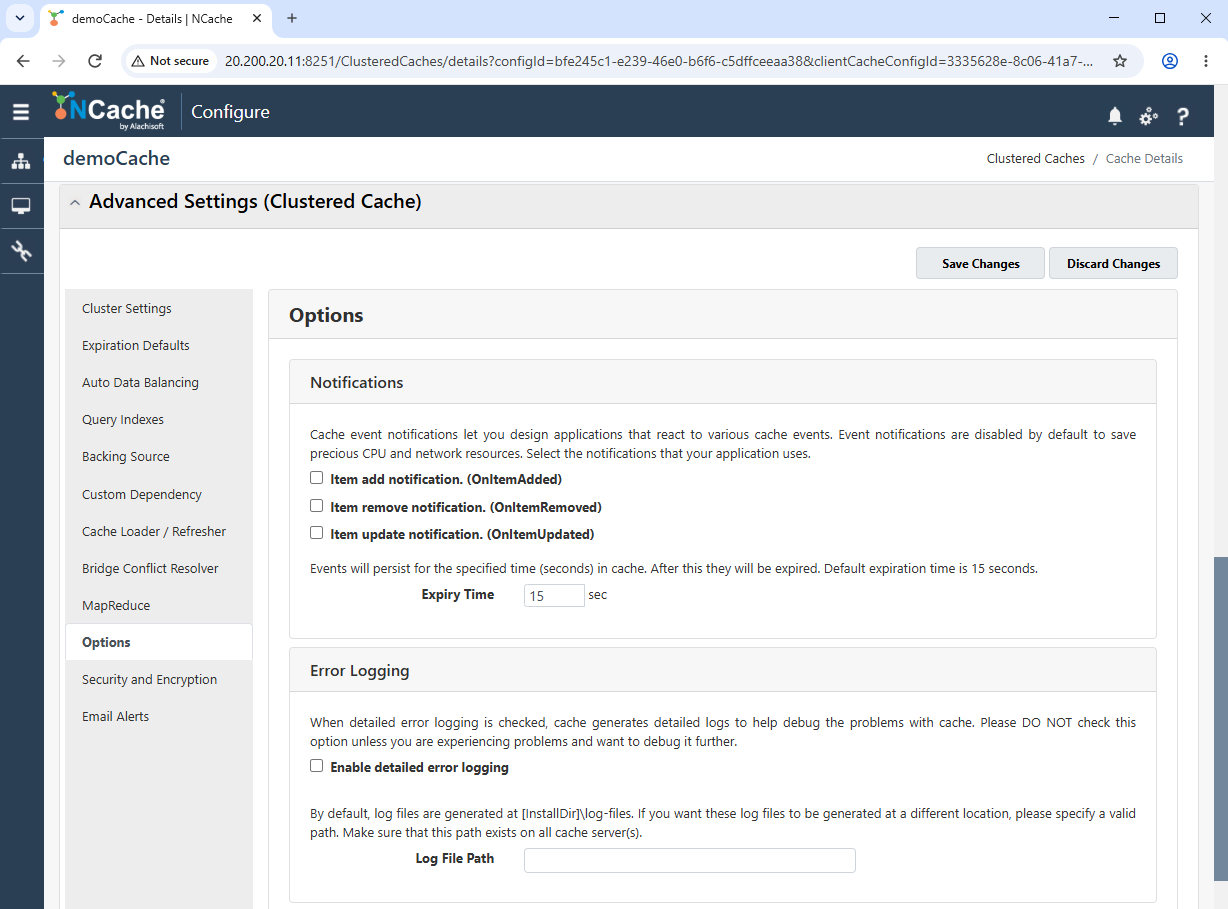
The Notifications section provides options for item-added, item-removed, and item-updated notifications. The Expiry Time field specifies the expiration-check interval for cache notifications.
The Error Logging section allows detailed error logging to be enabled and provides a Log File Path field.
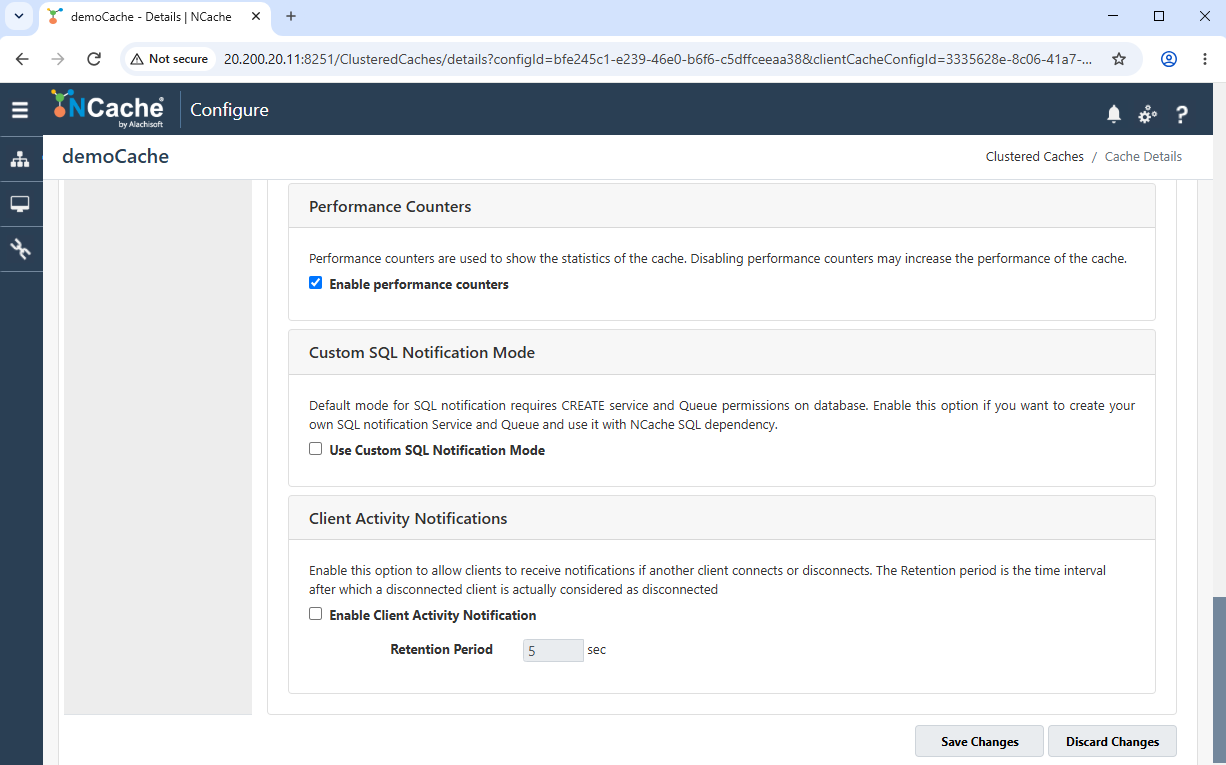
The Performance Counters section allows performance counters to be enabled or disabled.
The Custom SQL Notification Mode section allows a custom SQL notification service and queue to be used with NCache SQL dependency.
The Client Activity Notifications section allows notifications for client connection and disconnection activity to be enabled.
Retention Period specifies the interval after which a disconnected client is treated as disconnected for notification purposes.
Security and Encryption
The Security and Encryption page provides authorization and encryption settings for the clustered cache.
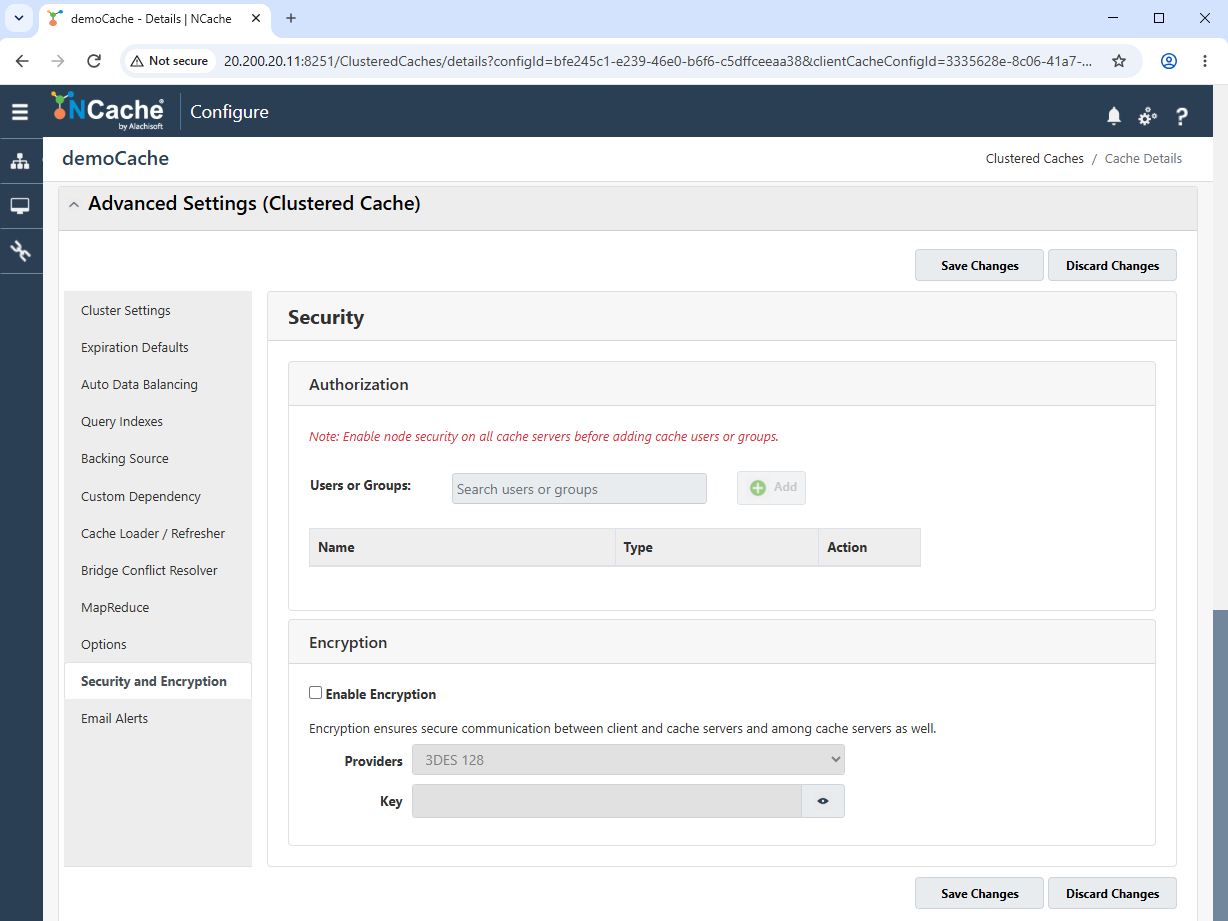
The Authorization section allows users or groups to be searched for and added to the cache authorization list. Node security must be enabled on the cache servers before users or groups can be added.
The Encryption section allows encryption to be enabled and provides fields for selecting an encryption provider and entering its key.
Email Alerts
The Email Alerts page provides SMTP and recipient settings for sending notifications when selected cache events occur.
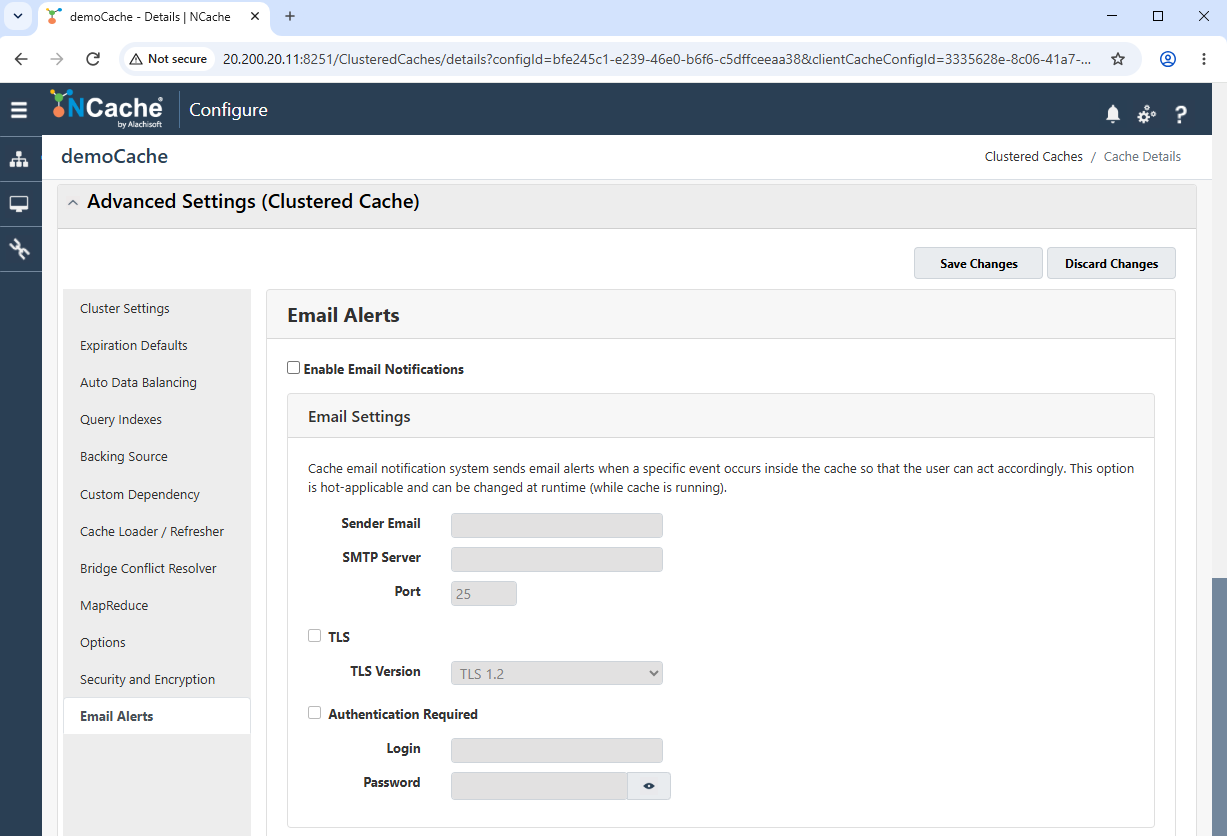
Select Enable Email Notifications to enable email alerts.
The Email Settings section contains fields for the sender email address, SMTP server, and port.
TLS can be enabled and a supported TLS Version can be selected.
SMTP authentication can be enabled by providing a login and password.
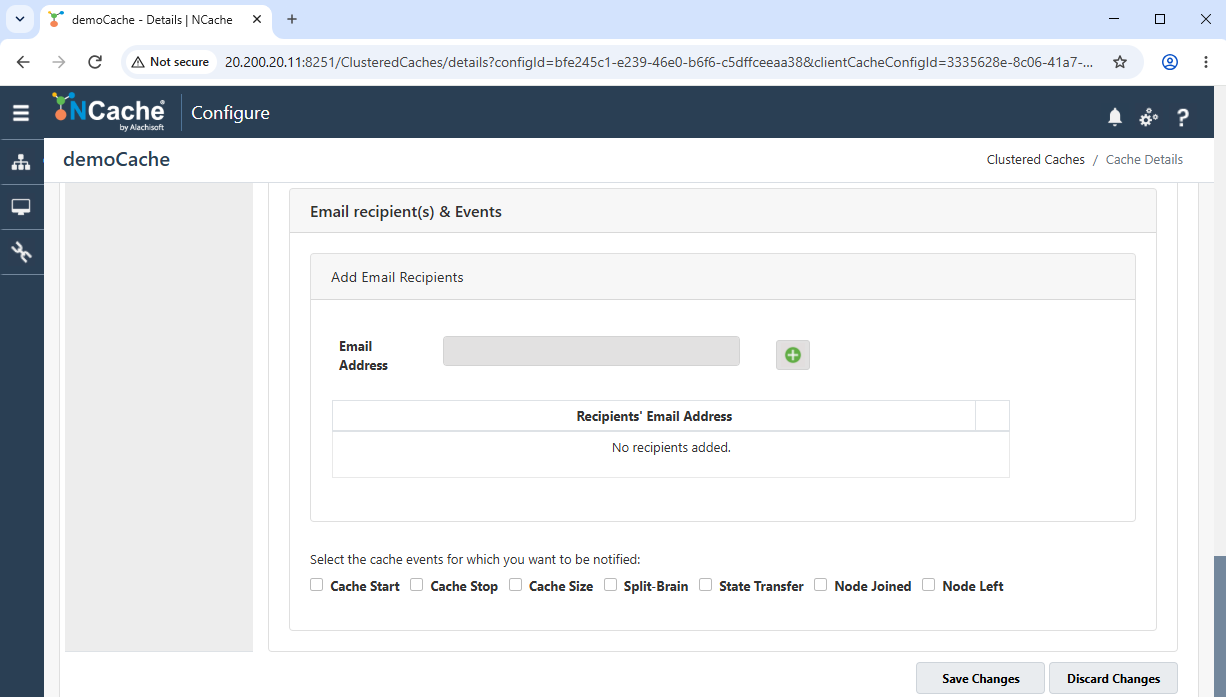
The Email recipient(s) & Events section allows recipient email addresses to be added and displays the configured recipients.
Notifications can be selected for the available events, including Cache Start, Cache Stop, Cache Size, Split-Brain, State Transfer, Node Joined, and Node Left.
At the bottom of this section, Save Changes and Discard Changes options are available to apply or revert modifications.
