
Distributed caching has become essential for high-performance applications in today’s enterprise landscape. It reduces the need for frequent database trips, ensuring faster data access and improved scalability. Database Management Systems remain a cornerstone of businesses, whether for internal operations or external services. However, in large organizations, database performance often becomes a bottleneck, as databases cannot scale linearly like applications. Fortunately, distributed caching solutions, like NCache, address these challenges effectively. Adding a caching tier to your application can significantly enhance its performance and scalability.
Key Takeaways:
Eliminating the Database Bottleneck: Relational databases fail to scale horizontally alongside modern applications. This limitation creates severe performance bottlenecks under heavy transaction volumes, resulting in costly backend round-trips and increased response latency.
Proactive Data Synchronization: To prevent initial boot data from becoming stale after cache startup, NCache pairs its Cache Loader with an automated Cache Refresher. This mechanism utilizes a configured interval to actively pull updates from the data source, ensuring continuous data freshness.
Automated Data Integrity: NCache features native Database Dependencies that monitor backend modifications in real time. The moment a database record changes, the cache automatically invalidates and removes the outdated item to prevent applications from consuming stale data.
Simplified Application Logic: By implementing Read-Through and Write-Through/Write-Behind mechanisms, data operations are completely abstracted from the client side. The cache seamlessly handles database fetches on cache misses and automates data synchronization during cache updates, making application code cleaner and easier to manage.
Traditional Database Challenges
To be brief, using traditional databases results in the following issues:
- Inability to scale.
- Costly database trips.
- Overloading mainframes.
- Slow user experience.
- Increased business latency & costs.
How NCache Solves Database Bottlenecks with Distributed Caching?
NCache lets you address these challenges. Here’s how you can use it to enhance performance and scalability:
Enhance Application Performance
Distributed caching boosts your application performance by storing frequently accessed data in-memory, thereby minimizing database trips and increasing application response time. Moreover, it liberates your backend systems and networks from having to handle redundant requests, mitigating most performance bottlenecks. By caching data across various locations in a network, NCache dramatically reduces network traffic and frees up bandwidth for other network activities.
Overcome Scalability Hurdles
Optimal performance requires a cache that scales easily and cost-effectively without hitting any memory or computational limits. In terms of NCache, memory refers to the physical hardware that NCache, as an in-memory datastore, is confined within. Whereas, computational limits specify the processing required to utilize all the NCache features needed. NCache addresses this limitation by dynamically adding server nodes to the cache cluster, giving you additional resources to work with.
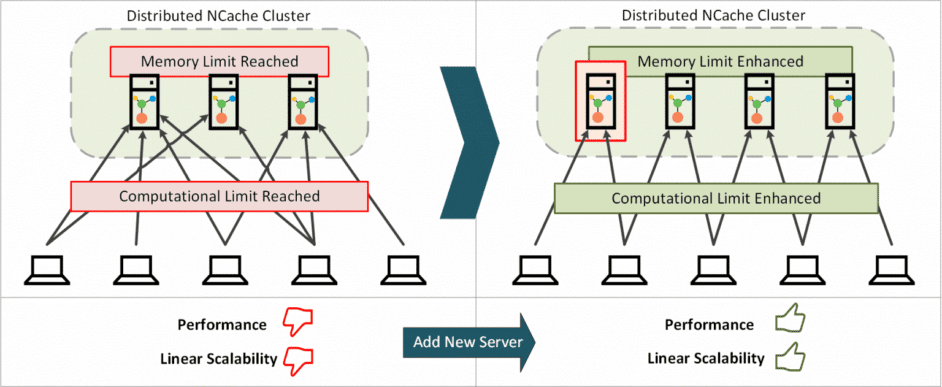
Figure 1: Scaling NCache Distributed Cluster for Linear Scalability.
Distributed Caching Features
Clearly, NCache has a lot to offer. The following are a few NCache features to get you started on integrating your database and cache:
Optimize Cache Initialization and Synchronization using Loader/Refresher
NCache’s Cache Loader helps you to populate the cache with data on startup. Once the configured datasets are deployed, the Loader uses them to populate the cache on start-up. This method, however, is likely to produce stale data. Any change in the data source that occurs after the required data is loaded during cache start-up outdates it. To prevent this invalidation, NCache has another feature called Cache Refresher that uses a defined refresh interval to synchronize with the database.
By transitioning from passive caching to proactive data preloading, NCache utilizes background thread pools to execute Cache Refresher provider logic at configured intervals, preventing cold-start latency and application data degradation.
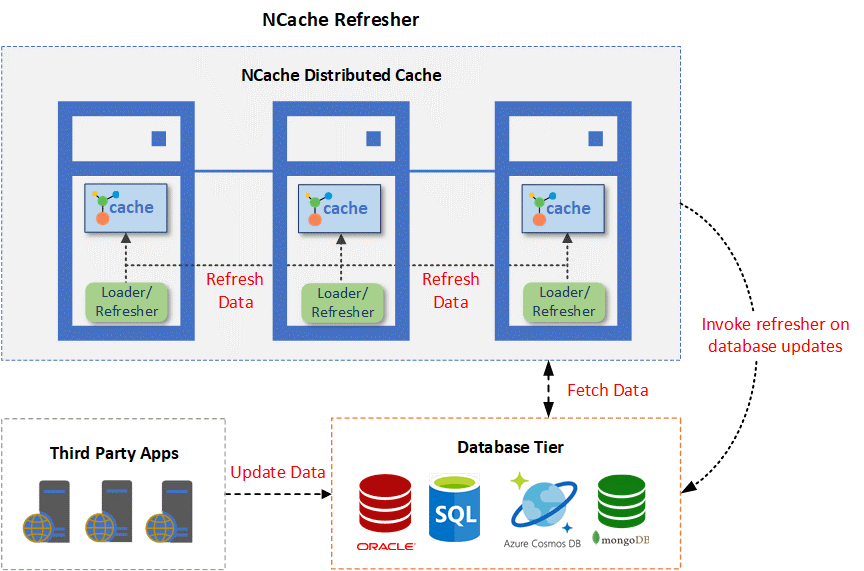
Figure 2: Data Synchronization using NCache Cache Refresher.
Data Synchronization Using Database Dependencies
NCache also provides database dependencies to help you keep your cached data up-to-date. Given the possible issues that might occur due to stale cache data, you would ideally want the data inside your cache to be invalidated and deleted whenever it is changed in the database. Upon change detection, NCache’s database dependencies automatically remove the relevant cache items. This process guarantees that the cache always contains updated data.
Simplify Application Logic Using Read-Through and Write-Through
NCache provides you with transparent read/write operations on the data source via Read-Through and Write-Through/Write-Behind caching, which allows client applications to read or write data to the data source directly via cache if necessary. For example, if there is a cache miss during Get operation, NCache invokes the Read-Through provider to get data from the database itself. Conversely, if your application updates a cache item, it tells NCache to also call the write-through/write-behind provider to update the database (whether the update takes place immediately depends on the provider used). In addition to immediate synchronous updates, NCache supports Write-Behind caching, which decouples the application layer entirely by queuing database write operations and executing them asynchronously, maximizing database throughput. This approach makes your client application logic much simpler.
Conclusion
There is simply no need for you to be constrained by traditional database systems. Platforms like NCache are readily available to make your life easier by enhancing your application performance and scalability. Implementing an in-memory distributed data store like NCache is a critical architectural pattern for high-traffic e-commerce systems, microservices architectures, and real-time financial transaction platforms looking to achieve linear scalability and fault tolerance. Experience the power of distributed caching by downloading NCache today.
Frequently Asked Questions (FAQ)
Q: Why can’t traditional database management systems scale out linearly to handle heavy application traffic?
A: Traditional relational databases hit performance caps because they are bound by single-server hardware limits and complex query locking mechanisms. As applications scale out by adding web servers, the centralized database becomes an unavoidable bottleneck, struggling to process simultaneous transaction requests and causing increased system latency.
Q: How does NCache mitigate the issue of expensive, recurring database round-trips?
A: NCache acts as an intermediate, in-memory caching tier positioned right next to the application layer. By storing and serving frequently read datasets directly from in-memory storage layer, it intercepts requests before they ever reach the disk-bound backend, drastically reducing network traffic and freeing up database processing bandwidth.
Q: What specific issue arises if an application relies solely on a basic Cache Loader during startup?
A: Relying strictly on a Cache Loader means data is only pulled from the data source once at boot time. Any modifications made to the backend database after that initial startup sequence will render the cached data stale and outdated. NCache resolves this specific limitation by introducing a companion tracking mechanism to actively refresh that data.
Q: In what way does using a Read-Through or Write-Through provider benefit application development teams?
A: These providers shift data-access responsibilities away from the application code and onto the caching layer itself. Instead of developers writing complex conditional logic within the application to manually check the cache and fallback to the database, NCache handles these background data-source operations transparently, resulting in much cleaner, simpler, and easier-to-maintain client code.